- Independent Corporate Structure: SBI Cards & Payment Services Limited is an independent listed NBFC distinct from State Bank of India. Local SBI bank branches cannot negotiate or settle credit card balances.
- Banker's Lien Inapplicability: Under Section 171 of the Indian Contract Act, 1872, SBI Bank cannot lawfully freeze or attach savings accounts in SBI Bank for unpaid SBI Card debts without express tripartite authorization.
- Waiver of Compounding Finance Fees: Annualized finance charges of 42% to 45% plus 18% GST and late payment fees can be 100% cancelled during formal compromise negotiations.
- Deep 60%–70% Lok Adalat Haircuts: SBI Card actively resolves defaulted card accounts in National Lok Adalats, issuing binding Civil Court Decrees that permanently terminate legal vulnerabilities.
- Mandatory 30-Day ₹0 NDC Delivery: Under RBI Circular RBI/2023-24/60, SBI Card must furnish a stamped No Dues Certificate and update credit bureau records to ₹0 balance within 30 days.
SBI Cards & Payment Services Limited: Corporate Entity Separation from State Bank of India
To navigate an SBI credit card default effectively, cardholders must first dismantle a widespread misconception: SBI Card is not a departmental division of State Bank of India (SBI Bank). SBI Cards & Payment Services Limited is an autonomous, publicly listed Non-Banking Financial Company (NBFC-ND-SI) incorporated under the Companies Act and regulated under the Reserve Bank of India's Prudential Framework. While State Bank of India remains the principal promoter holding a majority equity stake, SBI Card maintains an independent Board of Directors, a distinct balance sheet, dedicated statutory auditors, and a completely centralized risk and recovery infrastructure headquartered at DLF Infinity Towers in DLF Cyber City, Sector 25, Gurugram, Haryana.
This corporate demarcation holds critical legal and practical ramifications for distressed borrowers. Visiting a local SBI commercial bank branch to discuss an overdue SimplySAVE, SimplyCLICK, Prime, or Elite card account invariably leads to frustration. Branch Managers and retail banking staff possess zero technical access to SBI Card's core credit card ledgers, have no discretionary authority to alter ledger balances or waive penalty levies, and cannot lawfully execute or approve a One-Time Settlement (OTS). All collection policies, advocate empanelments, Section 25 PSSA demand notices, and compromise settlement approvals flow exclusively through the centralized Stressed Assets Management Desks in Gurugram.
Furthermore, this institutional separation shields borrowers against unlawful fund seizures. Under Section 171 of the Indian Contract Act, 1872, the statutory right of Banker's General Lien permits a bank to retain or set off deposits against debts owed to that specific corporate banking institution. Because State Bank of India and SBI Cards & Payment Services Limited are distinct legal juristic entities, SBI Bank cannot lawfully freeze, debit, or attach funds sitting in your SBI savings or current accounts to satisfy an unsecured credit card default, unless the cardholder expressly executed a specific tripartite standing instruction or contractual lien agreement at the time of card onboarding.
The Mechanics of SBI Card Financial Escalation: 42%–45% APR, GST & The Minimum Due Trap
The primary catalyst propelling manageable credit card balances into unmanageable financial liabilities is the compounding velocity of SBI Card finance charges. SBI Cards & Payment Services levies monthly finance charges ranging between 3.50% and 3.75% per month, generating an effective annualized percentage rate (APR) of 42.0% to 45.0%. Moreover, under Indian taxation statutes, every rupee of finance charges, late payment administrative penalties, and processing fees attracts a mandatory 18% Goods and Services Tax (GST), establishing an aggressive compounding spiral that rapidly decouples the cardholder's statement balance from the initial principal purchase amount.
For cardholders servicing only the Minimum Amount Due (MAD)—typically structured as 5% of the total outstanding balance plus accrued interest and EMI portions—the payment structure creates an acute economic illusion. In actuarial reality, approximately 75% to 85% of each minimum monthly remittance is consumed entirely by interest charges and statutory GST debits, with only a negligible fraction retiring the underlying principal. A cardholder carrying a ₹5 Lakh balance on an SBI Prime or SimplyCLICK card who pays only the MAD requires over 17 to 20 years to fully retire the obligation, ultimately paying more than 280% of the original principal in pure interest charges.
The moment a monthly installment is missed, SBI Card applies tiered late payment fees up to ₹1,300 per statement cycle, revokes interest-free grace periods retroactively on all transactions, and calculates daily compounding finance charges from the exact date of original purchase. When unforeseen economic shocks occur—such as sudden medical emergencies, commercial contract terminations, or job losses—an original ₹6 Lakh principal liability frequently inflates to ₹10 Lakhs within 12 to 14 months. Conducting a rigorous forensic ledger audit isolates the genuine principal expenditure from artificial interest layering, creating the foundational baseline for aggressive OTS negotiations.
SBI Card Delinquency Lifecycle: Days Past Due (DPD) to Non-Performing Asset (NPA)
SBI Cards & Payment Services Limited adheres strictly to the Reserve Bank of India's Prudential Norms on Income Recognition, Asset Classification, and Provisioning pertaining to Advances. The progression of an overdue credit card account through internal delinquency buckets dictates the operational escalation of collection efforts and determines the institutional authority of credit managers to sanction compromise haircuts.
The structured delinquency lifecycle advances across five progressive operational stages:
Stage 1: Days Past Due 1 to 30 (Special Mention Account 0 - SMA-0)
Automated tele-calling systems, interactive voice response (IVR) calls, SMS payment links, and email reminders are initiated immediately. Card spending privileges are temporarily suspended. Collections agents focus on encouraging immediate minimum payments or pitching high-interest EMI restructuring conversions, offering zero principal waivers.
Stage 2: Days Past Due 31 to 60 (SMA-1 Classification)
Account suspension becomes permanent. Internal tele-calling desks intensify outbound follow-ups. Delinquency late fees multiply on each statement date. Collections personnel issue verbal warnings regarding adverse CIBIL reporting impacts, but the issuer refuses core balance reductions.
Stage 3: Days Past Due 61 to 90 (SMA-2 Classification)
The account enters critical pre-NPA status. SBI Card assigns the file to external empaneled recovery agencies for localized field visits. Initial pre-litigation demand notices originating from Gurugram legal desks are dispatched to the cardholder's registered address.
Stage 4: Days Past Due 91 to 180 (Sub-Standard Asset / NPA Classification)
Under RBI guidelines, the debt is officially classified as a Non-Performing Asset (NPA). SBI Card must allocate mandatory balance-sheet provisioning against the unsecured loss. The account is routed to the Zonal Stressed Assets Management Desk in Gurugram, opening the formal window to negotiate 45% to 55% OTS debt waivers.
Stage 5: Days Past Due 181 to 365+ (Doubtful / Loss Asset & Write-Off)
The account requires up to 100% balance-sheet provisioning. The file is referred to National Lok Adalat conciliation benches or prioritized for pre-litigation compromise settlements. Settlement haircuts reach their maximum institutional ceiling of 55% to 70% of total ledger dues upon proving genuine borrower distress.
Net Present Value (NPV) Recovery Modeling: How SBI Card Evaluates Compromise Proposals
Contrary to common perception, credit card compromise settlements are not decided through arbitrary verbal arguments with collection tele-callers. Institutionally, SBI Cards & Payment Services evaluates One-Time Settlements using quantitative actuarial modeling governed by the Net Present Value (NPV) of recovery. Under Reserve Bank of India Master Directions on Compromise Settlements, regulated financial institutions must determine whether immediate lump-sum cash realization exceeds the discounted net recovery yield of pursuing multi-year civil litigation.
When assessing an NPA credit card account, SBI Card's Credit Committee analyzes three decisive economic variables: estimated timeline of court recovery (typically 3 to 6 years in Indian civil jurisdictions), legal expenditures (counsel retainers, court stamp duties, process server expenses), and balance sheet provisioning drag (100% loss reserves locked in non-earning accounts). If an advocate-represented borrower submits an immediate, verified one-time settlement proposal matching or exceeding this discounted net present value threshold, SBI Card's Stressed Assets Committee holds institutional mandate to execute substantial debt write-offs.
Where C_t represents estimated recoveries in year t, r is the NBFC cost of capital discount rate, and deductions account for 3–5 years of court friction, legal advocate retainers, and mandatory RBI NPA provisioning.
Realistic SBI Card Settlement Haircut Matrix by Card Product & Aging
| SBI Card Category | Delinquency Aging | Interest & Fee Waiver | Principal Haircut Range | Target OTS Settlement |
|---|---|---|---|---|
| SimplySAVE / SimplyCLICK | 90 – 180 Days (NPA) | 100% All Penal APR & Fees | 40% – 50% Principal Waiver | Pay 45%–55% of Principal |
| SimplySAVE / SimplyCLICK | 181 – 365+ Days (Doubtful/Loss) | 100% All Penal APR & Fees | 55% – 70% Principal Waiver | Pay 30%–45% of Principal |
| SBI Card PRIME / Elite | 90 – 180 Days (NPA) | 100% All Finance Charges | 35% – 50% Principal Waiver | Pay 50%–60% of Principal |
| SBI Card PRIME / Elite | 180+ Days (Written Off) | 100% All Finance Charges | 50% – 65% Principal Waiver | Pay 35%–50% of Principal |
| AURUM / Corporate Cards | 180+ Days (Stressed Assets) | 100% Penal Fees & Interest | 45% – 60% Principal Waiver | Pay 40%–55% of Ledger Dues |
SBI Card Credit Card Settlement & Legal Resolution Roadmap
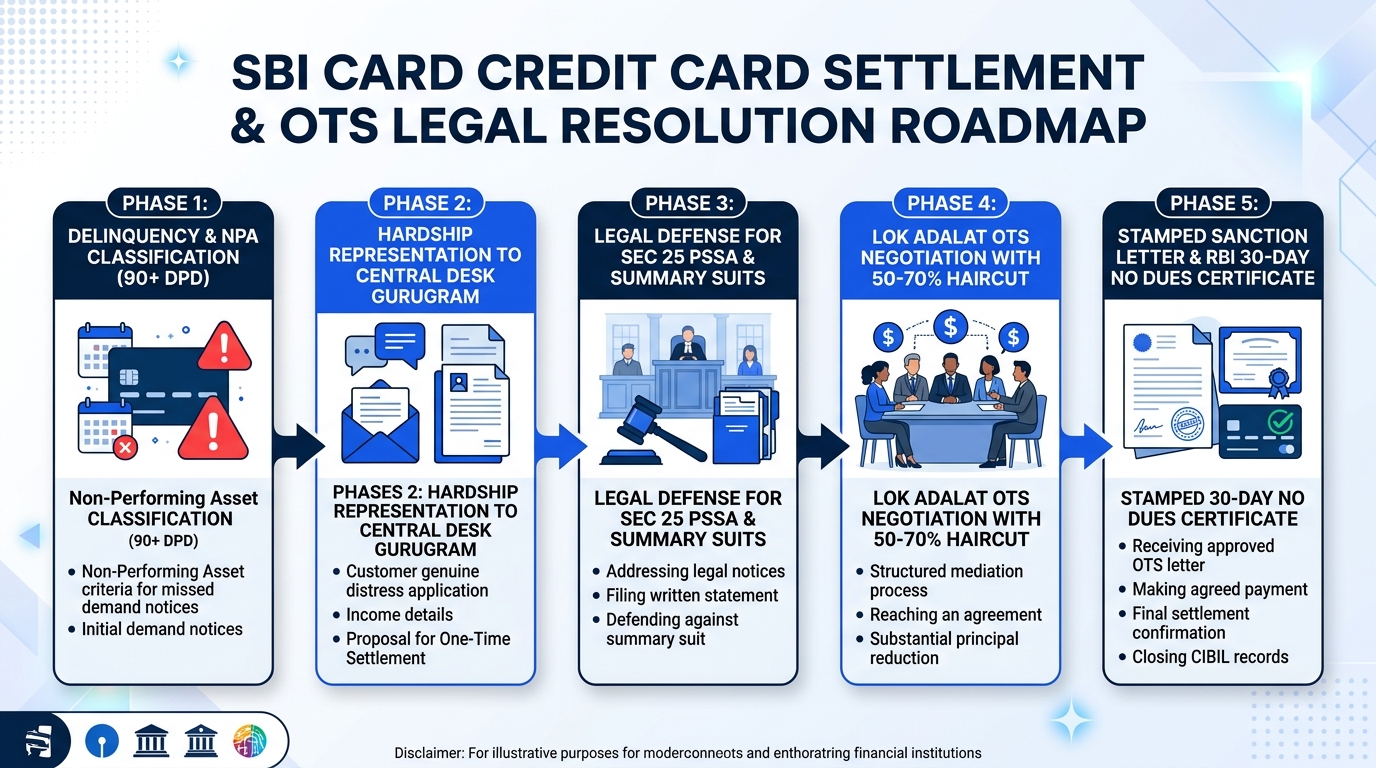
Demystifying SBI Card Gurugram Legal Notices: Section 25 PSSA, Section 138 NI Act & Summary Suits
SBI Cards & Payment Services Limited manages a centralized legal recovery apparatus operating out of DLF Cyber City, Gurugram, and New Delhi. When a credit card account crosses into 90+ DPD delinquency, borrowers nationwide routinely receive stern legal demand notices issued by empaneled legal advocates. These notices utilize formidable statutory citations intended to induce anxiety and compel immediate payment under duress.
Understanding the exact nature of these legal instruments empowers cardholders to respond methodically:
1. Section 25 Payment and Settlement Systems Act (PSSA), 2007: When an automated electronic NACH mandate or e-mandate presentation dishonours due to insufficient funds, SBI Card issues a statutory 15-day notice under Section 25 PSSA. While Section 25 operates similarly to Section 138 of the Negotiable Instruments Act, it is a bailable, compoundable quasi-criminal complaint adjudicated before a Judicial Magistrate. It is not an arrest warrant. With timely advocate representation, a formal reply demonstrating involuntary hardship prevents coercive summons and facilitates compounding through a compromise settlement.
2. Summary Recovery Suits under Order 37 Code of Civil Procedure (CPC), 1908: SBI Card empanelled counsel occasionally files summary suits before District Commercial Courts for liquid debt recovery. Unlike standard civil litigation, an Order 37 summons requires the cardholder to enter an appearance within 10 days and file an Application for Leave to Defend. Experienced banking advocates present triable legal issues—such as unconscionable annualized interest rates, disputed penalty levies, and procedural non-compliance—compelling the court to grant unconditional leave to defend and referring the dispute to mediation.
3. Section 138 Negotiable Instruments Act, 1881: If physical repayment cheques provided during restructuring or balance transfer requests bounce upon presentation, Section 138 proceedings may be initiated. These proceedings are fully compoundable and routinely disposed of with zero criminal liability upon executing an authorized OTS agreement.
Leveraging National Lok Adalats: Securing 60%–70% Waivers with Judicial Finality
SBI Cards & Payment Services Limited is among the most active institutional participants in quarterly National Lok Adalats organized by the National Legal Services Authority (NALSA) and State Legal Services Authorities (SLSA) across India. For borrowers seeking deep debt relief, National Lok Adalat benches represent the single most favorable and legally secure dispute resolution forum available.
During Lok Adalat sessions, SBI Card zonal credit officers are equipped with special pre-authorized recovery mandates designed to clear delinquent retail loan books. Because Lok Adalat conciliation is presided over by sitting or retired Judicial Officers and independent legal conciliators, negotiations occur in an equitable, intimidation-free environment. Credit managers readily agree to 100% waivers of all accrued finance charges, late fees, and GST, alongside 50% to 70% write-downs of original principal balances upon establishing genuine financial distress.
Crucially, a settlement executed before a National Lok Adalat carries unmatched statutory power. Under Section 21 of the Legal Services Authorities Act, 1987, every award passed by a Lok Adalat holds the status of a final decree of a Civil Court. No court fees are levied, no future appeal or revision lies before any court of law, and the underlying financial liability is permanently and irrevocably extinguished.
Step-by-Step Strategic Roadmap for Executing an SBI Card Online Compromise Settlement
Executing a secure, legally binding One-Time Settlement with SBI Cards & Payment Services Limited requires following a disciplined institutional protocol:
Download and examine 12 to 24 months of historical card statements. Separate actual merchant purchase principal from cumulative revolving finance charges, annual card fees, late payment charges, and GST surcharges to establish the true uninflated settlement baseline.
Serve a formal legal cease-and-desist representation to the Principal Nodal Officer of SBI Cards & Payment Services in Gurugram. Prohibit unauthorized third-party recovery calls to employers, colleagues, or relatives under RBI Fair Practices Codes.
Submit a formal OTS petition directly to SBI Card's centralized Stressed Assets Desk in Gurugram or through pre-litigation Lok Adalat channels. Include substantiated hardship evidence such as medical records, salary reduction letters, GST return declines, or bank statements.
Engage in structured counter-proposals with SBI Card zonal credit managers. Reject superficial 10%–15% discount offers and systematically negotiate down to an authorized 50% to 70% debt waiver based on account aging and loss provisioning.
Verify the authenticity of the official stamped OTS Sanction Letter issued on official SBI Card corporate letterhead. Remit settlement funds exclusively to your 16-digit SBI Card account number via official NEFT/RTGS banking rails.
Sanction Letter Forensics: Verifying Authenticity & Enforcing the RBI 30-Day NDC Mandate
The most perilous hazard in credit card debt resolution is remitting settlement funds based on verbal assurances or fraudulent discount letters fabricated by unauthorized external collection agencies. Third-party collection agents often pocket borrower funds or classify payments as partial installments, leaving the remaining ledger balance active and accumulating compounding finance charges.
Before remitting any payment, cardholders must verify the following four mandatory legal criteria:
- Official Corporate Letterhead: The document must be generated on official SBI Cards & Payment Services Limited letterhead displaying registered Corporate Identity Number (CIN: L65999HR1998PLC034160) and Gurugram registered office details.
- Complete Card Account Particulars: The letter must explicitly state the 16-digit SBI credit card account number, cardholder's full name, total ledger outstanding, agreed compromise settlement amount, and exact installment payment deadlines.
- Full & Final Settlement Discharge Clause: The text must unambiguously declare that receipt of the settlement sum constitutes complete liquidation of all claims and obligates the issuer to withdraw all pending legal notices, court complaints, or execution filings.
- Authorized Signatory Credentials: The letter must bear the digital or physical signature, employee designation code, and official departmental seal of an authorized SBI Card Credit Manager.
Under Reserve Bank of India Circular RBI/2023-24/60, SBI Cards & Payment Services Limited is statutorily mandated to issue a formal stamped No Dues Certificate (NDC) / Zero Balance Account Closure Letter within 30 calendar days of receiving full settlement funds. Should SBI Card fail to deliver the NDC within 30 days without lawful justification, it is legally liable to pay statutory compensation of ₹5,000 per day of delay directly to the borrower.
CIBIL Score Trajectory: Managing 'Settled' Status and Rebuilding to 750+ within 18–24 Months
Understanding the credit bureau impact of a One-Time Settlement is essential for long-term financial rehabilitation. When SBI Cards & Payment Services concludes a compromise settlement, it updates Credit Information Companies (CIBIL, Experian, Equifax, and CRIF High Mark) reflecting the account status as 'Settled' or 'Post-Write-off Settled' with a current outstanding balance of ₹0.
While a 'Settled' status results in an immediate CIBIL score drop of 75 to 140 points, it delivers a crucial systemic benefit: it permanently freezes compounding delinquency marks (such as rolling 90+ DPD tags), extinguishes civil legal exposure, and caps outstanding liability at zero. Over 18 to 24 months, cardholders can systematically restore their credit profile to prime 750+ levels:
| Rehabilitation Phase | Target Timeline | Primary Action Item | Expected CIBIL Trajectory |
|---|---|---|---|
| Phase 1: Zero Balance Audit | Month 1 – 2 | Verify ₹0 balance reporting across CIBIL, Experian & Equifax | Score stabilizes around 580–620 |
| Phase 2: Secured Credit Inception | Month 3 – 6 | Open a fixed-deposit (FD) backed secured credit card | Score climbs to 650–680 |
| Phase 3: Utilization Discipline | Month 7 – 12 | Maintain credit utilization strictly below 25% of secured limit | Score crosses 700–720 |
| Phase 4: Prime Credit Restoration | Month 13 – 24 | Service all utility bills and secured EMIs with zero default marks | Score reaches prime 750–780+ |

Settle Loan is India's trusted debt relief and loan settlement platform. We help borrowers overcome financial distress by negotiating with banks and NBFCs to legally settle personal loans and credit card debts. With our transparent, performance-based approach, you can achieve debt freedom and regain your financial peace of mind.
Media Mentions
COMPUTER
SBI Card Credit Card Settlement: Frequently Asked Questions
What is the SBI Card credit card settlement process in India?
Can I settle my SBI credit card at a local State Bank of India (SBI) branch?
Can SBI Bank freeze my savings account if I default on an SBI Credit Card?
What percentage of waiver or haircut can I expect in an SBI Card settlement?
How do I handle a Section 25 PSSA legal notice from SBI Card legal counsel in Gurugram?
Can SBI Card initiate criminal proceedings or send police to my home for card default?
How can I resolve my SBI Credit Card dues through National Lok Adalat?
How do I stop recovery agent harassment and workplace visits from SBI Card agencies?
How does an SBI Card settlement affect my CIBIL score and how can I restore it?
How long does SBI Card take to issue a No Dues Certificate (NDC) after settlement?
Official Statutory & Regulatory References
- Reserve Bank of India (RBI): Master Direction – Credit Card and Debit Card – Issuance and Conduct Directions, 2022 (Updated 2026)
- RBI Master Circular: Prudential Framework for Resolution of Stressed Assets and Compromise Settlements
- SBI Cards & Payment Services Ltd.: Grievance Redressal Policy, Most Important Terms & Conditions (MITC) & Nodal Officer Matrix
- Reserve Bank - Integrated Ombudsman Scheme, 2021: Online Complaint Portal for Card Harassment, Excessive Charges & NDC Non-Compliance
- National Legal Services Authority (NALSA): Legal Services Authorities Act, 1987 — National Lok Adalat Conciliation Framework