1. The ₹1 Lakh Threshold: Violent Compounding Interest & the Debt Spiral
In Indian retail banking, an unsecured credit card balance crossing the threshold of ₹1,00,000 represents a critical financial inflection point. Unlike amortized personal loans or home mortgages where interest is fixed against declining capital, credit cards function as revolving lines with annualized interest rates ranging between 42% and 48% APR. When converted to monthly finance charges, cardholders face a staggering 3.5% to 4.0% interest rate applied on a daily average balance calculation.
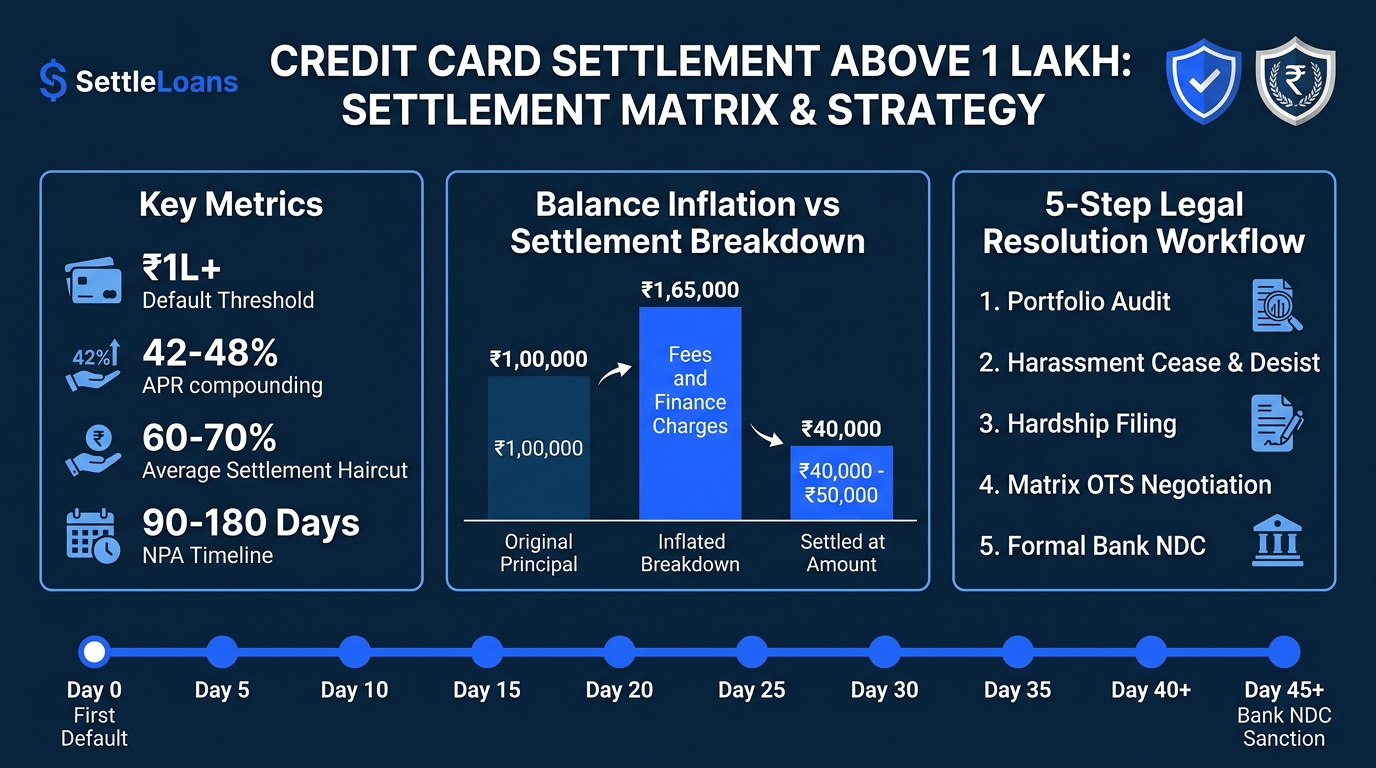
The moment a cardholder defaults on their minimum amount due (MAD) for two consecutive billing cycles, the credit card issuer revokes the interest-free grace period retroactively on all transactions. Finance charges then begin compounding not only on the raw purchase principal, but also on previously accrued unpaid interest, late payment penalties of up to ₹1,300 per month, over-limit surcharges, and a mandatory 18% Goods and Services Tax (GST) applied to every single fee. This toxic mathematical mechanism transforms a ₹1,00,000 balance into ₹1,45,000 to ₹1,65,000 in under nine months of non-payment.
2. Deconstructing the Inflated Balance: Disbursed Principal vs. Phantom Charges
To negotiate an effective One-Time Settlement (OTS), borrowers must recognize the fundamental accounting duality of credit card debt: the net principal balance versus accumulated phantom charges. The net principal represents the legitimate economic capital drawn by the cardholder for merchant swipes, e-commerce checkouts, or ATM cash advances. In contrast, phantom charges represent non-cash accounting accruals generated by the bank's automated billing software to penalize delinquency.
When commercial banks issue statement demands exceeding ₹1.5 Lakhs on an original ₹1 Lakh credit line, between 35% and 50% of that total outstanding figure consists entirely of phantom interest, late payment fines, finance charges, and tax levies. During formal compromise negotiations conducted by legal counsel, the primary objective is to demand a forensic statement audit, strip away 100% of these phantom additions, and then apply a substantial compromise haircut directly against the net principal.
| Billing Component | Original / 1 Month Due | 6–9 Months Default | OTS Settlement Target |
|---|---|---|---|
| Net Disbursed Principal | ₹1,00,000 | ₹1,00,000 (Base Capital) | ₹35,000 – ₹45,000 (Negotiated) |
| Compounding Finance Charges (42% APR) | ₹3,500 | ₹32,400 (Accrued) | ₹0 (100% Waived) |
| Late Payment & Over-Limit Penalties | ₹1,200 | ₹11,700 (Accumulated) | ₹0 (100% Waived) |
| GST on Charges & Penalties (18%) | ₹846 | ₹7,938 (Tax Levy) | ₹0 (100% Waived) |
| Total Statement Balance | ₹1,05,546 | ₹1,52,038 (Inflated) | ₹35,000 – ₹45,000 (65%–77% Overall Cut) |
3. Why Credit Cards Yield the Deepest Discounts: The Physics of 60%–70% Haircuts
A common question asked by distressed borrowers is why credit card issuers agree to settlement discounts of 60% to 70% of total statement dues, whereas home loans or vehicle loans rarely offer any principal reduction. The answer lies in the unsecured nature of revolving retail credit and bank profitability models. Credit card issuers operate on extraordinarily high gross margins from transacting cardholders who pay full finance charges and interchange merchant fees. Consequently, card portfolios are structured from inception with an anticipated loss allowance of 4% to 8% across the entire book.
Because credit cards lack physical collateral (such as real estate or hypothecated vehicles), the bank cannot initiate asset seizure under the SARFAESI Act, 2002. Furthermore, unlike personal loans that use mandatory electronic NACH mandates or post-dated cheques, credit card onboarding rarely includes security cheques. This eliminates immediate criminal prosecution mechanisms under Section 138 of the Negotiable Instruments Act. Faced with zero physical security and prohibitive civil litigation expenses, card issuers readily accept deep compromise settlements to recover base capital quickly.
4. Bank Provisioning, Write-Off Classifications & Loss Asset Dynamics
The willingness of a bank to grant deep settlement concessions is directly governed by Reserve Bank of India (RBI) Prudential Norms on Income Recognition, Asset Classification, and Provisioning pertaining to Advances. Understanding these regulatory milestones empowers borrowers with immense negotiation leverage at specific stages of delinquency.
When a credit card account crosses 90 days past due (DPD), it is classified as a Non-Performing Asset (NPA - Substandard). Under RBI regulations, the bank must begin setting aside capital provisions from its operational profits to cushion the bad debt. By 180 to 365 days of default, the debt is classified as a Loss Asset, requiring a mandatory 100% provisioning buffer. At this stage, the bank has already absorbed the loss on its audited balance sheet. Any cash collected through a One-Time Settlement represents a direct write-back to the bank's profit-and-loss statement, motivating credit committees to approve aggressive OTS discounts.
| Delinquency Phase | Asset Classification | Bank Provisioning | Achievable Settlement Haircut |
|---|---|---|---|
| 1 – 89 Days Past Due | SMA-0 to SMA-2 (Special Mention) | 0.4% – 5% Standard Provision | 10% – 25% (Fee waivers only) |
| 90 – 179 Days Past Due | Sub-Standard Asset (NPA Stage 1) | 15% – 25% Mandatory Provision | 35% – 50% on Total Outstanding |
| 180 – 365 Days Past Due | Doubtful / Charge-Off Asset | 50% – 100% Provisioned | 55% – 70% on Total Outstanding |
| 365+ Days (Assigned to ARC) | Loss Asset / Write-Off Book | 100% Full Provisioning | 65% – 75% on Total Outstanding |
5. Net Present Value (NPV) & Bank Settlement Decision Modeling
Bank credit committees do not accept settlement discounts out of charity; they make decisions based on rigorous mathematical risk modeling using Net Present Value (NPV) recovery formulas. When evaluating whether to accept an OTS proposal of ₹45,000 on an overdue balance of ₹1,50,000, the bank compares immediate liquid realization against the probabilistic future cash flow from outsourced collection agencies or protracted civil recovery suits.
The institutional recovery formula is expressed as:
For credit card balances between ₹1 Lakh and ₹5 Lakhs, filing a summary civil suit in a city civil court entails court fees, advocate drafting retainers, summons serving costs, and an average judicial delay of 4 to 7 years. Accounting for legal fees (₹25,000–₹45,000) and collection commission fees (15%–25%), the discounted recovery probability drops below 30%. Consequently, when an empaneled debt settlement advocate presents an upfront lump-sum OTS offer backed by documented hardship, the bank's risk matrix mathematically favors immediate settlement closure.
6. Legal Exposure on Credit Card Defaults: Civil Reality vs. Collection Myths
Distressed borrowers with card dues exceeding ₹1 Lakh are frequently subjected to unlawful threats from third-party recovery agents, claiming imminent police arrest, criminal non-bailable warrants, or immediate asset confiscation. It is vital to establish the precise legal framework governing credit card defaults in India under statutory law and judicial precedents.
Defaulting on an unsecured credit card is purely a civil contractual breach governed by the Indian Contract Act, 1872. The Supreme Court of India in landmark rulings (including ICICI Bank v. Shanti Devi Sharma) has unequivocally ruled that loan recovery must adhere strictly to the rule of law, and criminal intimidation by collection agents is an offense under Section 503 and 506 of the Indian Penal Code (IPC) / Bharatiya Nyaya Sanhita (BNS). Furthermore, the Debt Recovery Tribunal (DRT) has a statutory minimum jurisdiction threshold of ₹20 Lakhs under the RDBFI Act, meaning banks cannot drag a ₹1 Lakh to ₹5 Lakh cardholder to the DRT.
| Recovery Agent Threat / Myth | Statutory Legal Reality | Legal Protection / Remedy |
|---|---|---|
| "Police will arrest you at your home/office" | Civil defaults carry zero criminal arrest powers under Indian law. | RBI Circular 2022 Anti-Harassment filing; Police complaint for extortion. |
| "We have filed a Section 138 Cheque Bounce Case" | Sec 138 applies only if physical signed cheques bounced, not on credit cards. | Demand certified copy of cheque; reply via advocate showing no cheque issued. |
| "We will attach your ancestral property/salary" | Unsecured debt cannot attach property without a formal Civil Court decree. | Civil courts require 3–5 years trial; banks prefer compromise OTS settlement. |
| "Visiting friends, relatives, and workplace" | Expressly banned under RBI Fair Practices Code; breach of privacy. | Immediate Cease & Desist notice by SettleLoans advocate to bank compliance. |
7. Major Indian Card Issuers: Settlement Haircut Matrix Above ₹1 Lakh
Different commercial banks and Non-Banking Financial Companies (NBFCs) in India operate distinct internal recovery committees and settlement grids. Understanding the historical compromise behavior of major card issuers enables strategic timing and optimal price discovery during settlement discussions.
| Card Issuer / Bank | Average Default DPD for OTS | Typical Haircut Range | Settlement Approval Authority |
|---|---|---|---|
| HDFC Bank Credit Cards | 120 – 180 Days | 55% – 70% off Total Dues | Zonal Unsecured Credit Committee |
| SBI Card & Payment Services | 150 – 210 Days | 60% – 75% off Total Dues | National Risk & Settlement Panel |
| ICICI Bank Credit Cards | 120 – 180 Days | 50% – 68% off Total Dues | Regional Recovery Management Desk |
| Axis Bank Credit Cards | 135 – 190 Days | 55% – 70% off Total Dues | Special Collections & Compromise Cell |
| Kotak Mahindra Bank Cards | 150 – 210 Days | 60% – 72% off Total Dues | Asset Resolution Operations Team |
| RBL Bank & American Express | 120 – 240 Days | 50% – 65% off Total Dues | Senior Credit & Recovery Directorate |
8. Step-by-Step Strategic Playbook to Settle Credit Cards Above ₹1 Lakh
Successfully executing a high-value credit card settlement requires methodical adherence to formal banking protocols. Attempting ad-hoc verbal negotiations with outsourced telecallers almost invariably leads to broken agreements where payments are swallowed as partial interest without closing the liability.
The institutional five-stage resolution roadmap includes:
1Comprehensive Portfolio Audit & Phantom Charge Separation
Obtain detailed month-by-month card statements for the preceding 12 to 24 months. Segregate legitimate principal drawn from accumulated finance charges, late fees, annual membership dues, and GST surcharges to establish the true economic floor for negotiations.
2Issuing Legal Cease-and-Desist & Fair Practices Notice
Serve formal legal notice to the bank's principal officer and recovery desk under the RBI Master Direction on Fair Practices Code. Direct all future communications to your appointed legal counsel, halting unauthorized phone calls and third-party residential intrusions.
3Submitting Documented Hardship Dossier Under RBI Framework
Submit an exhaustive financial hardship petition detailing involuntary job loss, business insolvency, medical emergency expenditure, or severe cash flow distress supported by income tax returns, salary reduction slips, and bank statement verification.
4Direct NPA Committee Negotiation & OTS Sanction Letter Verification
Negotiate directly with the bank's internal credit settlement desk to secure a 60%–70% haircut. Ensure the formal compromise sanction letter is generated on the bank's official letterhead with clear terms, card number, settlement amount, and payment deadline.
5Payment Execution & ₹0 No Dues Certificate (NDC) Retrieval
Execute settlement payment directly to the bank's designated card collection account via NEFT/RTGS before the validity deadline. Track and obtain the official Final No Dues Certificate (NDC) confirming zero outstanding liability across all records.
9. CIBIL Bureau Reporting, Post-Settled Remarks & Score Rehabilitation
A critical consideration when executing a credit card settlement above ₹1 Lakh is the impact on your credit bureau report across TransUnion CIBIL, Experian, CRIF High Mark, and Equifax. Under the Credit Information Companies (Regulation) Act, 2005 (CICRA), the bank is legally required to report the resolution status as "Settled" or "Post (WO) Settled" rather than "Closed - Fully Paid".
Upon settlement, your CIBIL score will experience an immediate drop of 75 to 140 points, reflecting the compromise haircut. However, from a long-term financial health perspective, settlement is infinitely superior to perpetual delinquency. Settling terminates the ongoing accrual of 90+ DPD late payment markers each month and collapses your revolving Credit Utilization Ratio (CUR) from over 150% down to zero. By opening a secured fixed-deposit credit card 3 months post-settlement and maintaining disciplined repayment, borrowers consistently rebuild their CIBIL score to 750+ within 18 to 24 months. Furthermore, if your financial health improves, you retain the statutory right to pay the waived haircut later and convert the remark to "Closed".
10. Institutional Legal Defense & SettleLoans Representation Framework
Navigating aggressive recovery departments and complex NPA settlement committees alone often leads to anxiety, unfavorable settlement terms, or payment traps. SettleLoans provides a comprehensive, ethical legal defense and debt settlement platform designed to protect borrower dignity and secure the deepest permissible statutory discounts.
Our empaneled banking advocates step between you and the lenders, serving formal legal notices that instantly halt unauthorized phone calls and third-party visits. We audit your card statements to eliminate phantom interest, present an unassailable financial hardship dossier directly to senior credit risk officers, and secure genuine bank-issued OTS letters guaranteeing ₹0 No Dues Certificates with complete legal finality.

Settle Loan is India's trusted debt relief and loan settlement platform. We help borrowers overcome financial distress by negotiating with banks and NBFCs to legally settle personal loans and credit card debts. With our transparent, performance-based approach, you can achieve debt freedom and regain your financial peace of mind.
Media Mentions
COMPUTER
Frequently Asked Questions
Authoritative answers on credit card settlements above ₹1 Lakh under Indian banking regulations
Credit cards carry the highest borrowing cost in the retail banking sector, ranging from 42% to 48% annualized percentage rate (APR), charged on a monthly compounding basis (3.5%–4.0% per month). When a ₹1 Lakh balance goes unpaid, the bank applies late payment penalties (up to ₹1,300 per cycle), over-limit charges, 18% GST on all fees, and interest compounded daily on both principal and unpaid interest. Consequently, a ₹1 Lakh balance routinely compounds to ₹1.5 Lakhs within 6 to 9 months.
Credit card settlements typically yield discounts between 60% and 70% off the total inflated statement balance, and between 35% and 55% off the original principal amount. Because 40% to 50% of the accumulated balance consists of phantom finance charges and penal fees, bank settlement committees have substantial discretionary room to write off these non-principal components during One-Time Settlement (OTS) negotiations.
No. Credit card default is purely a civil contractual dispute governed by the Indian Contract Act, 1872. Credit cards do not involve post-dated cheques or automated NACH mandates in most cases, meaning Section 138 of the Negotiable Instruments Act or Section 25 of the Payment and Settlement Systems Act do not apply unless a repayment cheque specifically bounced. Banks cannot file criminal charges for genuine financial default.
Banks evaluate settlement offers using a Net Present Value (NPV) recovery model combined with credit card provisioning mandates. Once an account passes 90 days past due (NPA classification) and 180 days (charge-off), the bank provisions 100% of the balance as a loss asset. The recovery team's objective is to recover raw disbursed principal (at 45%–55% value) immediately rather than incurring prolonged legal expenses with negligible civil recovery probability.
The principal balance represents actual funds drawn or merchant transactions executed using the card. Inflated phantom charges encompass compounding finance charges (3.5%–4.0% monthly), late payment fees, annual membership charges, over-limit penalties, and 18% GST levied on all service charges. In a settlement negotiation, expert advocates strip away 100% of phantom charges and negotiate a haircut purely against the net principal.
Upon settlement, the bank reports the account to TransUnion CIBIL, Experian, CRIF High Mark, and Equifax with the remark "Settled" or "Post (WO) Settled", resulting in an immediate credit score reduction of 75 to 140 points. However, settling eliminates ongoing 90+ DPD late payment reporting and reduces your credit utilization ratio (CUR) to zero, allowing you to begin rebuilding your credit score using secured credit cards.
Under RBI compromise settlement frameworks, borrowers must establish bona fide financial distress. Acceptable documentary proof includes bank statements demonstrating severe cash flow exhaustion, job termination or salary reduction letters, medical diagnosis summaries and hospitalization invoices, business loss documentation, or proof of family bereavement.
Never make payments based on verbal promises or WhatsApp messages from collection agents. A valid settlement requires an official One-Time Settlement (OTS) sanction letter issued on the bank's official letterhead, specifying the card number, compromised settlement amount, exact payment due dates, and an explicit clause confirming that upon payment, the account will be closed with zero outstanding liability and a No Dues Certificate (NDC) issued.
Yes. If your financial circumstances improve in subsequent years, you can approach the card issuer, pay the previously waived haircut amount (the difference between the total dues and settled sum), and obtain a Final No Dues Certificate. The bank is legally mandated under CICRA regulations to update the credit bureaus from "Settled" to "Closed - Fully Paid".
Statutory References & Regulatory Frameworks
- Reserve Bank of India (RBI) Prudential Norms: Master Circular on Income Recognition, Asset Classification and Provisioning pertaining to Advances (IRACP).
- RBI Master Direction on Credit Card and Debit Card Operations (2022): Fair practice standards, interest calculation ceilings, and recovery guidelines.
- Credit Information Companies (Regulation) Act, 2005 (CICRA): Statutory reporting guidelines for TransUnion CIBIL, Experian, and Equifax.
- Indian Contract Act, 1872: Section 63 provisions governing remission and compromise agreements between creditor and debtor.
- Supreme Court of India (ICICI Bank v. Shanti Devi Sharma): Landmark ruling prohibiting third-party recovery agent harassment and coercion.