1. The Credit Card Debt Crisis in India: The 42% APR Minimum-Due Trap
Credit cards in India operate on the most predatory interest rate structures in the formal retail lending ecosystem. While secured home loans charge 8.5%–9.5% and personal loans range from 11% to 18%, credit cards charge astronomical finance charges of 3.0% to 3.75% per month—translating to an annualized percentage rate (APR) of 36% to 45% compounding.
When a cardholder is unable to pay the total statement balance in full by the due date, the banking algorithm triggers the dreaded revolving credit interest waterfall. Once revolving starts:
The standard 45-to-50 day interest-free period is immediately revoked. Daily compounding interest is charged retroactively from the exact transaction date of every single purchase.
Goods & Services Tax (GST) at 18% is automatically added to every rupee of monthly finance charges, late fees, and over-limit charges, accelerating balance growth.
The Minimum Amount Due (MAD) is approximately 5% of balance. Nearly 85% of your payment pays finance fees and GST, leaving the borrowed principal untouched.
The Mathematical Minimum Due Trap on a ₹2,00,000 Balance
If you carry a ₹2,00,000 credit card balance at 42% APR (3.5% monthly) and strictly pay only the 5% Minimum Amount Due (₹10,000 starting payment):
This mathematical reality explains why millions of middle-class salaried Indians and self-employed business owners feel trapped. You pay thousands of rupees every month, yet your card balance never shrinks. This is where legal debt settlement becomes a critical financial rescue tool.
2. Credit Card Settlement vs. Personal Loan Settlement: 6 Critical Structural Differences
Many borrowers assume that settling a credit card follows the identical playbook as settling a personal term loan. However, because credit cards are revolving unsecured credit lines rather than amortized term loans, the underlying legal, accounting, and settlement dynamics differ significantly.
| Comparison Parameter | Unsecured Credit Card Settlement | Personal Term Loan Settlement |
|---|---|---|
| 1. Debt Composition & Inflation | High Phantom Debt: 40%–60% of delinquent statement balance consists of compounding interest (42% APR), late fees, and 18% GST. | Pure Principal Base: 80%–90% of outstanding balance is original disbursed capital, with standard overdue interest (14%–24%). |
| 2. Bank Haircut Elasticity | Massive Waiver Flexibility (50%–70%): Banks readily waive 100% of accumulated interest and fees, negotiating primarily on the actual swiped principal. | Moderate Waiver Flexibility (40%–60%): Haircuts are scrutinized against the bank's hard capital loss on the disbursed principal. |
| 3. Criminal Cheque Bounce Exposure | Zero NI Act 138 Risk: Credit cards do not use Post-Dated Cheques (PDCs). Default is strictly a civil contractual breach. | Section 138 / Section 25 NACH Risk: Defaulted automated bank ECS/NACH mandates or security cheques can trigger court summons. |
| 4. Facility Status on Delinquency | Instant Limit Cancellation: Card is permanently suspended at 30–60 DPD; revolving privileges are permanently extinguished. | Amortization Halt: Loan tenure continues until marked as NPA; no revolving credit line is revoked. |
| 5. Multi-Card Contagion Risk | Spillover Risk: CIBIL delinquency triggers credit limit slashing or card freezing by other independent banks. | Isolated Loan Exposure: Other lenders generally do not recall existing term loans unless cross-collateralized. |
| 6. Final Closure Documentation | Account Closure & Card Cancellation Letter: Requires explicit ₹0 balance certificate and statement zeroing confirmation. | Comprehensive No Dues Certificate (NDC): Formally closes the specific loan account number across bank systems. |
Strategic Insight: Because the bank's true risk on a credit card is restricted to your actual merchant spends and cash withdrawals, legal advocates have tremendous leverage to strip away all accumulated compounding charges, late fees, and GST during OTS negotiations.
3. The 90-Day Delinquency & NPA Lifecycle for Credit Cards in India
Understanding how Indian banks classify delinquent credit card accounts under Reserve Bank of India (RBI) prudential norms is essential to timing your settlement for maximum financial relief while safeguarding your legal rights.
SMA-0 Stage (1 to 30 Days Past Due)
Automated SMS alerts, emails, and IVR calls begin. Late payment fees (₹500–₹1,300) and 3.5% monthly finance charges are debited to the card ledger. Bank front-line agents attempt to push the borrower to pay minimum dues. Settlement offers at this stage are impossible as the account is deemed regularizable.
SMA-1 & SMA-2 Stage (31 to 90 Days Past Due)
The card is permanently blocked from POS, ATM, and online transactions. The file is outsourced to third-party tele-calling collection agencies. Aggressive calling begins. Lenders may propose converting the entire outstanding amount into an EMI loan (often a trap that re-activates fresh interest commitments).
NPA Classification (90+ Days Past Due) — Prime Settlement Window
Under RBI Master Directions, the credit card is formally classified as a Non-Performing Asset (NPA). The bank is legally mandated to set aside capital provisions (15%–25% provisioning). The file moves from front-line collectors to the bank's Stressed Assets & Legal Compromise Desk. Legal advocates can now negotiate comprehensive One-Time Settlements with 40% to 70% waivers.
Technical Write-Off / ARC Assignment (180+ Days Past Due)
The bank writes off the bad asset from its primary balance sheet for tax efficiency (prudential write-off) or assigns the portfolio to an Asset Reconstruction Company (ARC). Settlement remains 100% possible and often results in deep haircuts (60%–75% waivers) to extinguish the ledger debt permanently.
4. Mathematical Financial Simulation: ₹5 Lakhs Credit Card Debt Workout
To demonstrate the real-world financial difference between continuing the minimum-due cycle, attempting debt consolidation, and executing an advocate-led OTS settlement, let us examine a typical case study of a borrower with ₹5,00,000 total credit card debt across two cards (HDFC and SBI Card).
| Financial Metric | Option 1: Minimum Amount Due (MAD) | Option 2: Debt Consolidation Loan | Option 3: Legal OTS Settlement |
|---|---|---|---|
| Total Outstanding Balance | ₹5,00,000 | ₹5,00,000 | ₹5,00,000 (Ledger) |
| Monthly Cash Commitment | ₹25,000 (declining over time) | ₹14,150 / month (fixed EMI) | ₹0 monthly EMI (OTS lump sum) |
| Repayment Tenure | 21 Years | 4 Years (48 Months) | 45 to 60 Days |
| Applicable Interest Rate | 42% Annual APR + 18% GST | 16.5% Fixed APR | 0% Interest (100% Waived) |
| Total Interest & Charges Paid | ₹16,40,000+ | ₹1,79,200 | ₹0 (All Penalties Waived) |
| Final Total Cash Outgo | ₹21,40,000+ | ₹6,79,200 | ₹2,00,000 – ₹2,25,000 |
| Net Financial Savings | ₹0 (Massive Loss) | Save on high APR only | ₹2,75,000 – ₹3,00,000 Cash Saved |
| CIBIL Score Trajectory | Maintains score (until missed) | Improves (requires 750+ to qualify) | Drops temporarily; rebuilt in 18–24 mo |
The Settlement Advantage: For a borrower facing genuine financial distress or job loss, attempting to service ₹25,000/month in minimum dues guarantees eventual insolvency. SettleLoans legal advocates eliminate all compounding charges and negotiate a verified compromise settlement of approximately ₹2.1 Lakhs, immediately stopping all collection harassment and closing the liability forever.
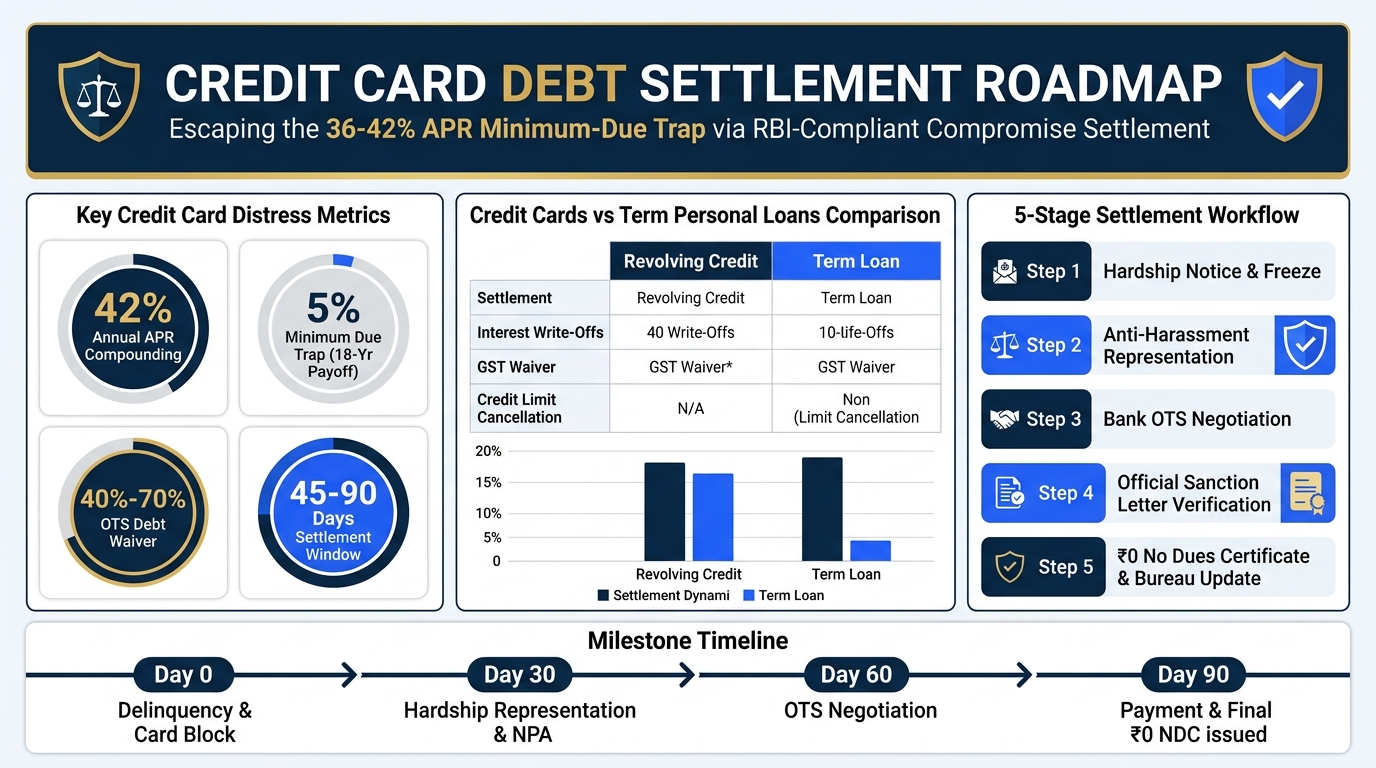
6. Step-by-Step Legal Blueprint to Settle Credit Card Debt in India
Settling credit card debt successfully requires a structured, multi-stage legal and financial negotiation strategy. Following this verified protocol ensures maximum debt waivers while completely insulating you from illegal collection harassment.
Step 1: Forensic Statement Audit & Phantom Debt Calculation
Download the last 12 months of credit card statements. Our legal analysts separate your Actual Principal Spend (physical transactions, fuel, merchant swipes, ATM cash) from Phantom Accumulated Debt (monthly 3.5% finance charges, late payment fees, over-limit penalties, and 18% GST). This establishes the authentic baseline for all OTS negotiations.
Step 2: Cease the Minimum Due Drain & Re-allocate Liquidity
Stop pouring hard-earned funds into revolving minimum amount dues that only subsidize bank interest profits. Re-route your monthly cash flow into a dedicated, secure settlement reserve account to accumulate the lump-sum settlement corpus required for the final compromise payoff.
Step 3: Issue Formal Legal Hardship Representation & Anti-Harassment Notice
Empaneled SettleLoans advocates issue a formal legal representation to the credit card issuer's Nodal Officer and Stressed Asset Cell. The notice documents your genuine economic hardship (medical records, job severance, business tax returns) under the RBI Master Directions and establishes advocate representation, ordering all third-party recovery agents to cease unauthorized calls.
Step 4: Strategic Negotiation with Bank Settlement Committees
Once the account crosses 90 DPD (NPA classification), our legal advocates engage directly with the bank's authorized Settlement Committee. We reject inflated ledger totals and negotiate exclusively on the core principal spend baseline, targeting a 40% to 70% total debt waiver.
Step 5: Rigorous Legal Verification of Official Bank Settlement Letter
Before a single rupee is paid, our legal team scrutinizes the settlement letter against 7 forensic security checks. We verify bank letterhead authenticity, unique settlement reference numbers, card number masking, waiver breakdown, payment deadline, and the explicit clause guaranteeing ₹0 balance and NDC issuance.
Step 6: Payment Execution Exclusively via Direct Banking Channels
The agreed settlement sum is remitted directly into the bank's designated card account via NEFT/RTGS/NetBanking using official transaction references. Never pay in cash or transfer funds to any recovery agency's private account.
Step 7: Procuring Official ₹0 No Dues Certificate & Credit Bureau Tracking
Within 15 to 45 days of payment, we obtain the bank's signed and sealed Comprehensive No Dues Certificate (NDC) confirming complete liability closure. We track monthly bureau filings with TransUnion CIBIL, Experian, and CRIF High Mark to ensure the outstanding balance is marked as exactly ₹0.
7. RBI Regulations & Borrower Anti-Harassment Protections
Credit card recovery in India has historically been fraught with aggressive collection practices. To curb these abuses, the Reserve Bank of India has enacted stringent, binding regulatory directives that protect delinquent cardholders:
- Calling Hours: Agents are legally restricted to contacting borrowers only between 8:00 AM and 7:00 PM.
- Third-Party Privacy: Strict ban on contacting family members, friends, neighbors, or workplace colleagues regarding debts.
- Workplace Visits: Unauthorized visits to a borrower's employer or place of business are strictly prohibited.
- Zero Intimidation: Complete prohibition on abusive language, physical threats, or psychological harassment.
- Compromise Settlement Framework: Regulated entities must maintain board-approved OTS policies for stressed card accounts.
- Unsolicited Cards & Limit Upgrades: Lenders cannot upgrade limits or levy hidden charges without explicit written consent.
- Clear MITC Disclosures: All finance charges, annual fees, and compounding methods must be transparently declared.
- Ombudsman Redressal: Direct escalation pathway to the RBI Banking Ombudsman (RB-IOS) for recovery malpractices.
8. Bank-Specific Credit Card Settlement Realities in India
While all scheduled commercial banks adhere to RBI guidelines, each major card issuer operates internal settlement matrices, delegated financial authority limits, and standard waiver ranges:
| Credit Card Issuer | Typical Waiver Range | Installment Flexibility | Settlement & NDC Dynamics |
|---|---|---|---|
| HDFC Bank Credit Cards | 50% to 65% Waiver | 1 to 3 Monthly Installments | Direct settlement via Stressed Asset Desk; NDC issued in 21–30 working days post-clearance. |
| SBI Card (SBICPSL) | 55% to 70% Waiver | 1 to 2 Installments Preferred | Operates through specialized SAMB branches; offers substantial waivers during National Lok Adalat sessions. |
| ICICI Bank Credit Cards | 50% to 65% Waiver | 1 to 3 Monthly Tranches | Prompt digital settlement sanction letters; highly responsive to formal advocate hardship representations. |
| Axis Bank Credit Cards | 45% to 60% Waiver | 1 to 3 Installments | Strict scrutiny of borrower income proof; requires formal hardship documentation for deep haircuts. |
| Kotak Mahindra Bank | 50% to 65% Waiver | 1 to 2 Installments | Fast-track compromise approvals when represented by empaneled legal counsel. |
| RBL Bank Credit Cards | 55% to 70% Waiver | Bullet Payment Preferred | Aggressive early-stage calling that subsides immediately upon service of formal legal notices; high waiver elasticity at NPA. |
| Standard Chartered & Amex | 40% to 60% Waiver | 1 to 4 Monthly Tranches | MNC issuers mandate structured documentation; excellent compliance with formal settlement letters and bureau zeroing. |
9. Post-Settlement CIBIL Score Rehabilitation & ₹0 No Dues Certificate Verification
Executing a settlement provides instant psychological and legal peace of mind by eliminating active collection threats. However, managing your credit bureau footprint post-settlement is vital for your long-term financial freedom.
Understanding the "Settled" Remark in CIBIL
Under the Credit Information Companies (Regulation) Act, 2005, banks report settled accounts as "Settled" with a Current Balance of ₹0. This indicates that the lender accepted a compromise haircut and the borrower has zero active financial or legal liability.
The 24-Month Credit Rebuilding Protocol (750+ CIBIL)
- Step 1: Secure a Fixed-Deposit-backed credit card (e.g. IDFC WOW, OneCard FD, Axis Dream) with a ₹25,000–₹50,000 deposit.
- Step 2: Maintain credit utilization strictly between 15% and 25% of the FD limit (e.g., utility bills, groceries).
- Step 3: Enable 100% auto-debit to guarantee zero missed due dates for 18 consecutive months.
- Result: Your score naturally rises from 600–650 back to 750+ within 18 to 24 months.
Future Option: Converting "Settled" to "Closed" Status
If your financial situation significantly improves in future years and you wish to apply for a major corporate mortgage or international visa requiring a spotless credit history, you can approach the original lender, pay the previously waived haircut amount (the discount), and obtain a Comprehensive Final No Dues Certificate. The lender is legally bound to update CIBIL and Experian from "Settled" to "Closed - Fully Paid".

Settle Loan is India's trusted debt relief and loan settlement platform. We help borrowers overcome financial distress by negotiating with banks and NBFCs to legally settle personal loans and credit card debts. With our transparent, performance-based approach, you can achieve debt freedom and regain your financial peace of mind.
Media Mentions
COMPUTER
Expert Answers to Critical Credit Card Debt Settlement Queries
Detailed, search-optimized answers addressing legal rights, bank negotiation tactics, CIBIL impacts, and settlement procedures.
The Minimum Amount Due (MAD) is mathematically engineered to protect the lender's yield while keeping the borrower indebted for decades. In India, MAD is calculated at approximately 5% of the total outstanding balance (or accumulated interest + taxes + 1% of principal). Because credit cards levy 36% to 42% annualized compounding finance charges (3.0% to 3.5% per month) plus 18% GST from the date of each swipe once the balance revolves, over 80% to 90% of your monthly payment goes toward service charges and taxes. Clearing a ₹3 Lakhs balance by paying only the minimum due takes over 18 to 22 years and results in paying more than ₹10 Lakhs in total cash outgo.
Personal loans are closed-ended term facilities with fixed monthly EMIs and a rigid principal amortization schedule. In personal loans, default occurs on a verifiable, fixed principal balance. Conversely, credit cards are unsecured revolving credit facilities where 40% to 60% of a delinquent balance consists of "phantom debt" (compounding finance charges, late payment penalties, over-limit fees, and 18% GST). In a credit card settlement, banks have much wider margin elasticity to waive 100% of interest, penal fees, and GST, agreeing to a 40% to 70% haircut on the actual principal spend. Furthermore, standard credit cards do not involve auto-debit NACH mandates or cheques, eliminating criminal Section 138 bounce exposure.
No, for standard revolving card bills. In India, credit cards are issued without post-dated cheques (PDCs). Therefore, non-payment of regular monthly statements is a purely civil contractual dispute and cannot trigger Section 138 Negotiable Instruments Act criminal proceedings. However, if you explicitly converted large card transactions into an EMI plan backed by an auto-debit NACH mandate that bounced, or if you handed over a physical settlement cheque that dishonored, lenders can issue statutory notices under Section 25 of the Payment and Settlement Systems (PSS) Act, 2007 or Section 138 of the NI Act.
Leading Indian credit card issuers (including HDFC Bank, SBI Card, ICICI Bank, Axis Bank, Kotak, RBL, and IndusInd Bank) typically settle delinquent credit card accounts at 30% to 50% of the total outstanding statement balance (equivalent to a 50% to 70% overall waiver). The exact haircut depends on the account's delinquency stage (accounts at 90–180+ DPD receive higher waivers), verified borrower hardship documentation (loss of employment, medical crisis, business insolvency), and negotiation representation by experienced debt settlement advocates.
When you settle a delinquent card, that specific account is permanently blocked and cancelled. Other active credit cards issued by different banks are not automatically cancelled on day one. However, credit bureaus (TransUnion CIBIL, Experian, CRIF High Mark, Equifax) update your credit profile monthly. When your other lenders run periodic portfolio reviews and observe severe delinquency remarks or a "Settled" status on one card, automated risk management algorithms may drastically reduce your credit limits, block reward point redemptions, or restrict further transactions to prevent risk contagion.
A credit card account reaches prime settlement eligibility once it crosses 90 Days Past Due (DPD) and is formally classified as a Non-Performing Asset (NPA) under RBI prudential provisioning norms. Prior to 90 DPD (during SMA-0 and SMA-1 stages), front-line bank collection desks focus on regularizing the account with late fee concessions. Once an account becomes an NPA (90 to 180+ DPD), banks are mandated by the RBI to allocate 15% to 100% provisioning reserves, transferring the file to Stressed Assets and Legal Recovery desks authorized to sanction substantial compromise haircuts.
A genuine bank settlement sanction letter MUST satisfy five mandatory criteria: 1) Issued directly on the bank's official letterhead with corporate branch details and executive signature/digital watermark; 2) Explicitly state your full name, PAN, 16-digit (masked) credit card number, and unique settlement reference ID; 3) Clearly list the exact settlement amount, waiver sum, and strict payment due date; 4) State unequivocally that upon payment, the account will be closed with ₹0 outstanding dues and a formal No Dues Certificate (NDC) will follow; and 5) Specify payment exclusively through official bank portals, NEFT/RTGS to bank collection accounts, or direct card payment—never to an individual recovery agent's personal UPI or account.
Under the RBI Master Direction on Recovery Agents and Fair Practices Code (RBI/2022-23/108), recovery agents are strictly barred from: calling before 8:00 AM or after 7:00 PM, calling friends, relatives, or office colleagues, visiting your workplace without prior authorization, using threatening or abusive language, or attempting public shaming. If agents violate these norms, you can file a formal complaint with the Bank's Principal Nodal Officer, lodge a complaint on the RBI CMS portal (RB-IOS), and initiate legal complaints for criminal intimidation under Sections 351/352 of the Bharatiya Nyaya Sanhita (BNS).
Settling a credit card causes an immediate CIBIL score drop of 75 to 120 points, and the credit report lists the account status as "Settled" with a ₹0 current balance. While unsecured personal loans and premium credit cards will be restricted for 12 to 18 months, your credit profile is legally protected from active default proceedings. By adopting a structured credit rehabilitation strategy—such as obtaining a Fixed-Deposit-backed (FD-secured) credit card, maintaining credit utilization below 25%, and repaying on time—you can rebuild your CIBIL score back to 750+ within 18 to 24 months.
Yes. While single-bullet payments secure the deepest discounts (60% to 70% waivers), credit card issuers routinely approve structured compromise plans spread across 2 to 4 monthly installments for borrowers facing severe liquidity constraints. When negotiating an installment settlement, ensure that the multi-part payment schedule and dates are explicitly documented in the bank's formal sanction letter before making the first payment.
Statutory References & Official Regulatory Sources
- Reserve Bank of India (RBI): Master Direction – Credit Card and Debit Card – Issuance and Conduct Directions, 2022 (Updated 2024/2026).
- Reserve Bank of India (RBI): Framework for Compromise Settlements and Technical Write-offs (RBI/2023-24/40 DOR.STR.REC.20/21.04.048/2023-24).
- Reserve Bank of India (RBI): Master Direction on Recovery Agents and Fair Practices Code for Regulated Entities (RBI/2022-23/108).
- Credit Information Companies (Regulation) Act, 2005 (CICRA): Mandatory credit bureau reporting rules for TransUnion CIBIL, Experian, CRIF High Mark, and Equifax.
- Payment and Settlement Systems Act, 2007: Section 25 electronic mandate bounce statutory regulations and civil dispute limits.