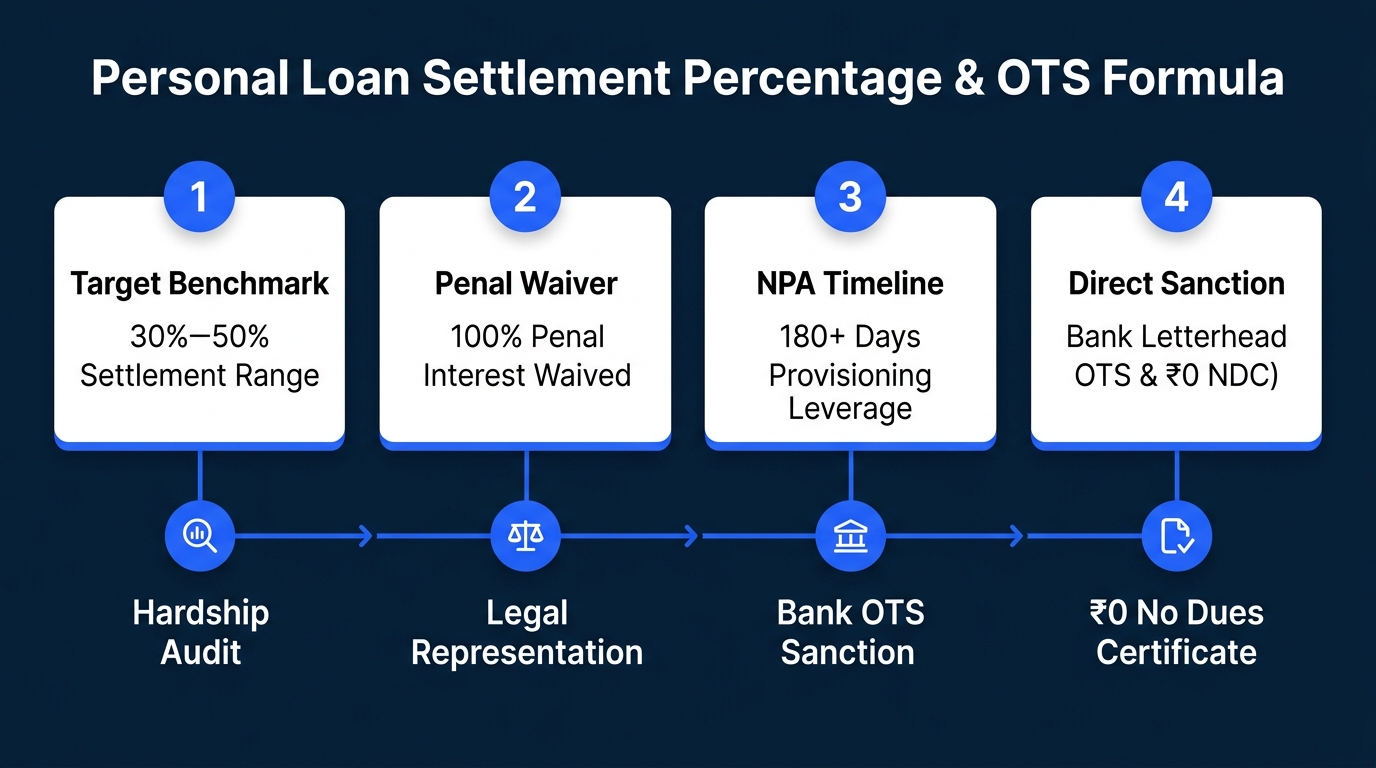
- The Industry Benchmark: In India, standard personal loan settlements close between 30% and 50% of total accumulated dues, delivering a net 50% to 70% cash saving for the distressed borrower.
- Settlement % vs. Haircut %: Understand the math clearly: A "40% Settlement" means you pay 40% of the claim and the bank waives 60% as a haircut. On a ₹10 Lakh default, you pay ₹4 Lakhs and save ₹6 Lakhs.
- Penal Charge Elimination First: Legitimate legal negotiations mandate 100% waiver of accrued late fees and 24%–36% penal interest before calculating principal compromise percentages.
- The NPA Provisioning Sweet Spot: Settlements reach their lowest percentage targets (30%–40%) after the account has crossed 180+ days of default (Doubtful NPA classification), when banks face severe RBI provisioning costs.
- Direct Bank Sanction & ₹0 NDC: All payments must be deposited directly into your designated bank loan account against a stamped OTS Sanction Letter on official bank letterhead, followed by a formal No Dues Certificate.
1. What Percentage is Personal Loan Settlement in India? The 30%–50% Standard Explained
When borrowers experience severe financial disruption—such as sudden job termination, critical illness, or business collapse—repaying an unsecured personal loan in full becomes mathematically impossible. In this situation, the single most urgent question borrowers ask is: "What percentage will my bank actually accept to close this loan permanently?"
Across scheduled commercial banks, private sector lenders, and non-banking financial companies (NBFCs) in India, the verified industry average for a One-Time Settlement (OTS) ranges between 30% and 50% of the total claimed dues. In situations involving acute hardship, prolonged default, or disputes resolved in National Lok Adalats, settlement figures can drop as low as 25% to 35% of the principal balance.
Settlement Amount Percentage (What You Pay)
This represents the exact proportion of the outstanding debt you must arrange in cash to satisfy the lender's compromise demand. For example, a 35% settlement on a ₹10,00,000 total claim means you pay ₹3,50,000 to fully discharge the debt.
Haircut / Discount Percentage (What You Save)
This is the proportion of the loan the bank agrees to write off and permanently forgive. In the same example above, paying ₹3,50,000 yields a 65% haircut (₹6,50,000 net savings) for the borrower.
Deconstructing the Bank's Claim: Why Total Dues Are Inflated
When a borrower defaults on EMIs for 6 months, a loan with an original ₹5 Lakh balance suddenly balloons into a ₹7.5 Lakh demand notice. Lenders artificially inflate default balances using three distinct layers:
1. Base Principal Outstanding (The Real Debt)
The actual disbursed capital remaining unpaid after accounting for all successful historical EMI payments.
2. Contractual Accrued Interest
The normal annualized interest rate (e.g., 12% to 18% p.a.) calculated during the non-payment period.
3. Compounded Penal Charges & Bounce Penalties (Negotiable to Zero)
Exorbitant penalty interest (often 24% to 36% p.a. compounded monthly) plus ₹500–₹1,000 NACH bounce charges per sweep. In professional settlement negotiations, 100% of this third layer is waived immediately.
2. The Bank's Internal OTS Formula: How Lenders Calculate Settlement Percentages
Banks and NBFCs do not pick settlement figures at random. Every compromise offer generated by a lender's Stressed Asset Resolution Branch (SARB) is governed by strict mathematical risk models, Net Present Value (NPV) recovery equations, and the Prudential Norms on Income Recognition and Asset Classification (IRAC) mandated by the Reserve Bank of India.
The Economic Driver: Why RBI Provisioning Forces Banks to Settle
When an unsecured personal loan misses 3 consecutive EMI cycles (90 days), it is classified as a Non-Performing Asset (NPA). Under RBI regulations, the bank is legally barred from recognizing accrued interest as income and is forced to set aside cash reserves (provisions) directly from its operating profits to cover potential default losses:
- Substandard NPA (91 to 365 Days): The bank must maintain a mandatory 15% to 25% capital provision on unsecured debt.
- Doubtful-1 NPA (12 to 24 Months): Provisioning escalates to 40% to 100% of the unsecured balance.
- Loss Asset (>24 Months): The loan is categorized as completely uncollectible, requiring 100% full provisioning write-off.
Strategic Insight: When you offer a 35%–45% lump-sum settlement on a Doubtful NPA, the bank instantly recovers hard cash, releases its 100% locked provisioning reserve back into profit, and clears toxic non-performing assets off its balance sheet.
Default Vintage vs. Expected Personal Loan Settlement Percentage Matrix
| Default Stage & Vintage | RBI Classification | Bank Provisioning % | Realistic Settlement % (What You Pay) | Expected Discount / Haircut % |
|---|---|---|---|---|
| Days 1 – 60 (1 to 2 Missed EMIs) | SMA-0 / SMA-1 | 0% (Standard) | 85% – 100% | 0% – 15% (Interest waiver only) |
| Days 61 – 90 (3rd Missed EMI) | SMA-2 (Pre-NPA) | 0% (Standard) | 75% – 90% | 10% – 25% (Penal charges waived) |
| Days 91 – 180 (3 to 6 Months) | Substandard NPA | 15% – 25% | 50% – 65% | 35% – 50% (Substantial interest haircut) |
| Days 181 – 365 (6 to 12 Months) | Doubtful NPA (D-1) | 40% – 100% | 35% – 48% | 52% – 65% (Optimal negotiation window) |
| Days 365+ (1 to 2+ Years) | Doubtful / Loss Asset | 100% Provisioned | 25% – 38% | 62% – 75% (Maximum discount potential) |
3. The 5 Crucial Determinants That Decide Whether You Get a 30% or 70% Settlement
Why does one borrower settle a ₹10 Lakh loan for ₹3.2 Lakhs (32%) while another borrower is offered only ₹6.5 Lakhs (65%)? Settlement percentages are not static—they hinge directly upon 5 verifiable legal, financial, and procedural factors:
1Verifiability & Severity of Genuine Financial Hardship
Banks distinguish ruthlessly between a genuine stressed borrower and a wilful defaulter. Providing ironclad documentary evidence—such as a formal pink slip/termination letter, medical oncology/surgery discharge summaries, GST cancellation certificates, or bank statements showing zero credit inflows—convinces the credit committee that legal recovery will yield zero return, unlocking 30%–40% settlement tiers.
2100% Unsecured Nature & Inapplicability of SARFAESI Act
Unlike home loans or vehicle loans where lenders can confiscate pledged physical assets within 60 days under the Securitisation and Reconstruction of Financial Assets and Enforcement of Security Interest (SARFAESI) Act, 2002, personal loans carry zero asset hypothecation. The bank cannot touch your residential flat, family car, or household belongings without winning a protracted civil summary suit (Order 37 CPC), which takes 4 to 7 years in Indian civil courts.
3Payment Structure: Single Lump-Sum vs. Multi-Tranche Installments
Cash in hand today is worth infinitely more to a bank manager than promises of future installments. Offering to wire 100% of the agreed settlement sum within 7 to 15 banking days consistently secures an additional 8% to 15% discount compared to requesting a 3 to 6-month installment plan.
4Default Vintage & Write-Off Classification
The older the default, the lower the bank's valuation of the asset on its books. When a loan has migrated from internal collections to external recovery agencies and ultimately into the bank's bad-debt ledger (written-off portfolio), settlement desks possess wide discretionary powers to accept nominal compromise payments.
5Professional Legal Advocacy vs. Direct Vulnerable Negotiation
When individual borrowers negotiate directly, recovery call centers exploit their fear of police or court notices to extract 70%–80% payments. When empaneled legal advocates represent the borrower under the RBI Fair Practices Code and Indian Contract Act, negotiations bypass aggressive collection agents and proceed directly with authorized Zonal Managers and SARB credit heads.
4. Bank & NBFC Comparison Matrix: Expected Settlement Percentages by Lender Type
Not all financial institutions operate under identical regulatory mandates. Public sector banks, private commercial giants, and digital fintech NBFCs handle loan default resolution through distinct operational frameworks:
Comprehensive Personal Loan Settlement Comparison Across Indian Lenders
| Lender Category | Representative Institutions | Typical Settlement % Range | Average Haircut / Savings % | Negotiation Flexibility & Speed | Most Effective Resolution Forum |
|---|---|---|---|---|---|
| 1. Public Sector Banks (PSUs) | State Bank of India (SBI), PNB, Bank of Baroda, Canara Bank | 50% – 65% of Principal | 35% – 50% Haircut | Low flexibility; strict policy guidelines; requires committee approval | National Lok Adalat & Board-Approved OTS Schemes |
| 2. Top Tier Private Banks | HDFC Bank, ICICI Bank, Axis Bank, Kotak Mahindra Bank, IndusInd | 35% – 48% of Total Claim | 52% – 65% Haircut | Moderate to High; data-driven risk models; fast 15-day approvals | Direct SARB Legal Representation & Nodal Negotiation |
| 3. Retail & Consumer NBFCs | Bajaj Finance, Tata Capital, Aditya Birla Capital, Poonawalla Fincorp | 30% – 45% of Total Claim | 55% – 70% Haircut | High flexibility at 120+ days; aggressive initially, compromise-friendly later | Advocate Escalation to Central Legal & Dispute Desks |
| 4. Digital Lending Apps & Fintechs | KreditBee, MoneyTap, Navi, CASHe, PaySense, Ring | 25% – 40% of Total Dues | 60% – 75% Haircut | Very High flexibility after 90 days; eager to clear digital NPA pools | Formal Legal Notice citing RBI Digital Lending Guidelines |
5. Fund Planning & Negotiation Playbook: How to Arrange Capital and Settle at the Lowest %
Understanding the target settlement percentage is only half the battle. The critical practical challenge is arranging the necessary compromise funds without plunging into new high-cost debt traps. Follow this structured 5-step fund planning and negotiation playbook:
1Calculate Your Target Settlement Fund Pool (The 35% Benchmark)
Take your original unpaid principal balance (ignore penal charges). Calculate 35% to 40% of that figure. This represents your target settlement capital. For example, if your unpaid principal is ₹6,00,000, your target pool is ₹2,10,000 to ₹2,40,000. Start quietly accumulating this amount across 3 to 6 months in a non-lending bank account.
2Identify Ethical Liquidity Sources (Never Take Micro-Loan Apps)
Never borrow from predatory 7-day mobile loan apps or take credit card cash advances to settle a personal loan. Safe liquidity avenues include: 1) Friendly, interest-free loans from immediate family members; 2) Partial liquidation of non-essential physical assets; 3) Provident Fund (PF/EPFO) partial withdrawal under non-employment/medical clauses; 4) Modest gold pledge at single-digit sovereign rates.
3Anchor Initial Offers at 20%–25% to Settle at 35%–40%
When formal settlement discussions open with the bank's SARB or nodal desk, submit an initial hardship compromise proposal anchored at 20% to 25% of total dues, accompanied by your hardship dossier. The bank will inevitably counter at 50%–60%. This leaves ample negotiating headroom to meet at the optimal 35%–42% sweet spot.
4Reject "Partial Payment for Tenure Extension" Traps
Recovery callers frequently demand ₹20,000 to ₹50,000 as an "advance token" promising they will "hold the account" or "apply for settlement later." Never pay a single rupee without an official sanction letter. Token payments are instantly swallowed by the bank as penal interest without reducing principal or preventing further recovery action.
5Execute Settlement Solely Against Official Bank Letterhead Sanctions
The bank must issue a formal One-Time Settlement (OTS) letter containing: your exact loan account number, full borrower name, final compromise amount, strict payment timeline, explicit waiver of balance dues, and an undertaking to issue a ₹0 No Dues Certificate and update credit bureaus within 30 days.
6. Real-World Case Calculations: How Settlement Percentage Math Works in Practice
To see exactly how settlement percentage formulas translate into real cash savings, review these three verified settlement case studies resolved by SettleLoans empanelled advocates across different loan sizes and borrower profiles:
Case Study 1: Salaried IT Professional (₹8.5 Lakhs Total Claim • Job Loss)
Settled at 36.5% (Saved ₹5.4 Lakhs)| Parameter | Lender Claim Before Legal Intervention | Advocate Negotiated OTS Sanction | Net Relief / Savings |
|---|---|---|---|
| Principal Balance | ₹5,80,000 | ₹3,10,000 (Settlement Sum) | ₹2,70,000 Principal Waived |
| Accrued Regular Interest | ₹1,45,000 | ₹0 | ₹1,45,000 (100% Waived) |
| Penal Charges & Bounce Fees | ₹1,25,000 | ₹0 | ₹1,25,000 (100% Waived) |
| Total Liability | ₹8,50,000 | ₹3,10,000 (36.5% of Total Claim) | ₹5,40,000 Net Haircut (63.5%) |
Resolution Context: HDFC Bank personal loan default of 210 days. SettleLoans advocates submitted the corporate layoff letter and bank statement showing zero income. Settled in a single lump-sum tranche with official ₹0 NDC issued within 21 days.
Case Study 2: MSME Trader with Multi-Lender Debt (₹14.2 Lakhs Total Claim • Business Loss)
Settled at 39.4% (Saved ₹8.6 Lakhs)| Lender | Total Claimed Dues | Final OTS Amount | Settlement % | Net Savings |
|---|---|---|---|---|
| ICICI Bank Personal Loan | ₹6,20,000 | ₹2,40,000 | 38.7% | ₹3,80,000 |
| Bajaj Finance Flexi Loan | ₹4,80,000 | ₹1,90,000 | 39.5% | ₹2,90,000 |
| Axis Bank Unsecured Credit | ₹3,20,000 | ₹1,30,000 | 40.6% | ₹1,90,000 |
| Consolidated Portfolio | ₹14,20,000 | ₹5,60,000 | 39.4% (Average) | ₹8,60,000 (60.6% Net Haircut) |
Resolution Context: Multi-creditor debt across 3 institutions. SettleLoans orchestrated a coordinated legal representation, synchronized default timelines to prevent cross-litigation, and negotiated structured 2-installment settlements for all three accounts.
Case Study 3: Acute Medical Hardship (₹5.0 Lakhs Default • National Lok Adalat)
Settled at 30.0% (Saved ₹3.5 Lakhs)A teacher in Pune defaulted on a ₹5,00,000 SBI personal loan following open-heart surgery and subsequent loss of employment. The total claim had risen to ₹6,40,000 with interest. Represented by SettleLoans advocates at the Pune District National Lok Adalat, the matter was presented before the judicial bench with medical documentation.
Final Lok Adalat Award: ₹1,50,000 (30.0% of Original Principal / 23.4% of Claimed Dues)
The judicial award was signed with immediate effect, having the force of a final non-appealable civil decree. Full No Dues Certificate handed over on the spot.
7. CIBIL Impact, Tax Implications (Sec 194R) & The 750+ Credit Rebuild Roadmap
While settling a personal loan for 35%–45% delivers immediate financial freedom and halts all legal risk, borrowers must understand the post-settlement regulatory and credit realities:
How Credit Bureaus (CIBIL, Experian, CRIF) Record a Settlement
Under the Credit Information Companies (Regulation) Act (CICRA 2005), lenders are legally mandated to report settled credit accounts accurately. The account status is tagged as "Settled" rather than "Closed", and the balance is marked as ₹0.
The Real-World Impact: Your credit score will experience a temporary drop of 75 to 150 points. However, having a "Settled" account with ₹0 dues is vastly superior to carrying an "Active Written-Off / 900+ DPD Default" status that compounds monthly and prevents you from ever obtaining future credit.
Tax Treatment of Waived Loan Percentages (Income Tax Act & Section 194R)
For Salaried Borrowers (Personal Consumption): Loan principal waivers on genuine personal consumption loans are treated as capital receipts/remissions and do not attract income tax under Section 194R or Section 28(iv).
For Business / Professional Borrowers: If you availed an unsecured loan for business working capital and previously deducted the interest as a business expenditure, the waived portion may be scrutinized under Section 41(1) or Section 28(iv) as remission of trading liability. Ensure your settlement agreement specifies the non-commercial nature of the compromise.
The 4-Step Blueprint to Rebuild Your CIBIL Score Back to 750+ in 18–24 Months:
Verify Bureau ₹0 Balance
Download your CIBIL report 45 days post-settlement. Verify that the outstanding balance reflects exactly ₹0 and all active delinquency tags have ceased.
Obtain Secured Credit Card
Open a Fixed Deposit (FD) of ₹25,000–₹50,000 with a bank offering secured cards (e.g., IDFC FIRST WOW or Kotak 811 Dream Different) without income checks.
Maintain <25% Utilization
Use only ₹5,000–₹10,000 of your limit for recurring utilities and groceries. Set up auto-debit for 100% total bill repayment on or before the due date.
Avoid Unsecured Inquiries
Refrain from applying for unsecured credit cards or personal loans for at least 12 months. Every hard rejection damages your recovering score trajectory.

Settle Loan is India's trusted debt relief and loan settlement platform. We help borrowers overcome financial distress by negotiating with banks and NBFCs to legally settle personal loans and credit card debts. With our transparent, performance-based approach, you can achieve debt freedom and regain your financial peace of mind.
Media Mentions
COMPUTER
8. Frequently Asked Questions (FAQ): Personal Loan Settlement Percentages
Find clear, authoritative answers to the most critical legal, mathematical, and procedural questions regarding loan settlement percentages in India:
In Indian banking practice, an unsecured personal loan settlement typically ranges between 30% and 50% of the total outstanding claim (translating to a 50% to 70% discount/haircut). In cases of acute, documented hardship—such as severe medical disability, permanent job loss, or business insolvency—and where the loan has remained in default for more than 180 to 360 days, experienced settlement advocates frequently secure OTS closures at 25% to 35% of the principal balance.
Lenders initially issue settlement offers against the total outstanding claim, which bundles unpaid principal, accrued regular interest, 24%–36% penal interest, late fees, and bounce charges. However, during formal advocate-led negotiations, legal counsel first mandates a 100% complete waiver of all penal interest and bounce charges. The final compromise percentage is then negotiated directly against the base principal balance.
Personal loans are 100% unsecured credit facilities. The lender holds no underlying physical collateral (unlike mortgages or auto loans) and cannot invoke summary asset seizure under the SARFAESI Act, 2002. Furthermore, under Reserve Bank of India (RBI) prudential provisioning guidelines, banks must set aside between 15% and 100% capital provisions from their operating profits for non-performing assets. Recovering 30% to 50% cash upfront in an OTS enables the bank to release locked capital and avoid years of expensive civil litigation.
Yes, achieving a 20% to 30% settlement is viable under specific conditions: 1) The account has aged into a Doubtful (D-2/D-3) or Loss Asset classification (typically 12 to 24+ months of continuous non-payment); 2) The borrower provides conclusive documentary proof of permanent income loss; or 3) The matter is settled before a sitting judge during a National Lok Adalat organized by NALSA, where institutional lenders are incentivized to clear dead debt portfolios.
During the initial 1 to 90 days (SMA-0 to SMA-2 stage), banks rarely offer discounts over 10%–20% on accrued interest because recovery teams still expect full repayment. Between Days 91 and 180 (Substandard NPA), provisioning kicks in and settlement offers typically land between 45% and 60%. Beyond 180 to 360+ days (Doubtful NPA), maximum provisioning pressure forces lenders to accept the deepest haircuts, making 30% to 45% settlement deals achievable.
Public Sector Banks (such as SBI, PNB, and Bank of Baroda) operate under rigid, board-approved One-Time Settlement schemes and are subject to strict vigilance audits by the CVC and CAG. Consequently, PSU banks generally demand 50% to 70% of the principal balance. Conversely, private lenders (HDFC, ICICI, Axis, Kotak) and fintech NBFCs (Bajaj Finserv, Poonawalla) operate with dynamic, risk-modeled recovery desks that can sanction flexible haircuts of 30% to 45% to clear distressed retail books rapidly.
While the deepest percentage discounts (e.g., 30%–35%) are unlocked with a single, immediate lump-sum payment, most banks allow structured settlements across 2 to 4 monthly installments. However, choosing installment tranches usually results in a slightly higher settlement percentage (e.g., 40%–45%) because lenders price in the risk of default on subsequent installment dates.
For individual salaried borrowers, the waived principal portion of an unsecured personal consumption loan represents a capital remission and is generally not considered taxable income under the Indian Income Tax Act. However, for self-employed individuals or business loans where interest was previously claimed as a tax deduction, Section 194R and Section 28(iv) may treat loan waivers as taxable business remission. Always obtain clear legal and tax counsel during settlement structuring.
When an account is settled at a discount, the bank reports the loan to TransUnion CIBIL, Experian, and CRIF High Mark as "Settled" with a ₹0 outstanding balance. This triggers an immediate credit score dip of 75 to 150 points. However, because active legal exposure and compounding default interest are permanently eliminated, you can systematically rebuild your credit score back to 750+ within 18 to 24 months using disciplined credit-builder instruments.
Never make any payment based on verbal assurances or WhatsApp messages from recovery agents. You must first secure an official OTS Sanction Letter printed on the bank's registered letterhead, detailing your exact loan account number, agreed settlement amount, and payment deadline. Pay only into your designated loan account via RTGS/NEFT, and demand the issuance of a formal No Dues Certificate (NDC) within 15 to 30 days of final payment.
Authoritative Legal & Regulatory Sources
- Reserve Bank of India (RBI) — Master Circular on Prudential Norms on Income Recognition, Asset Classification (IRAC) & Provisioning
- TransUnion CIBIL — Credit Information Companies (Regulation) Act, 2005 (CICRA) Settlement Reporting Norms
- National Legal Services Authority (NALSA) — National Lok Adalat Compoundable Debt Compromise Framework
- Supreme Court of India — Landmark Jurisprudence on Fair Practices in Debtor Recovery & Unsecured Credit
- RBI Complaint Management System (CMS) — Integrated Ombudsman Scheme for Banking Grievances