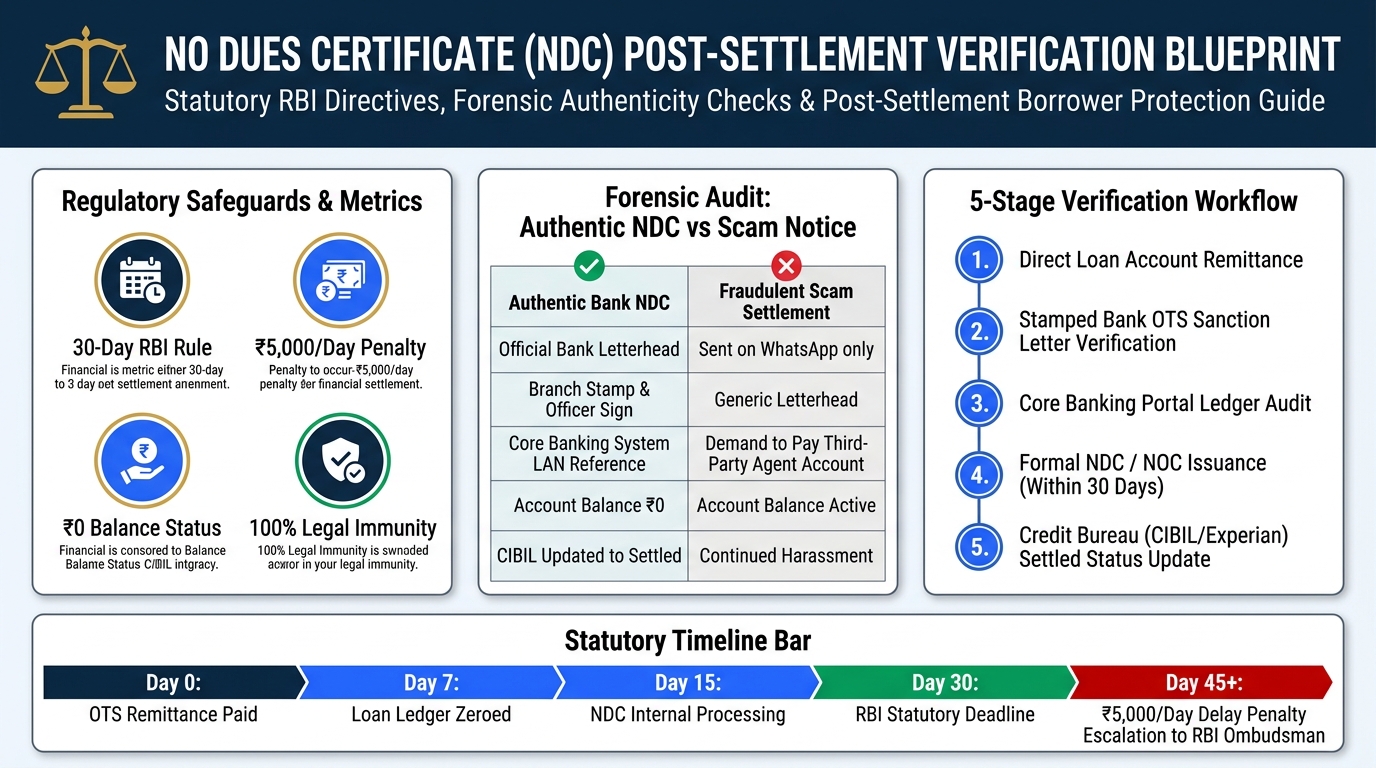
- Payment is Not the Finish Line: Simply remitting the compromise settlement amount does not automatically protect you. You must secure an official, stamped No Dues Certificate (NDC) on the lender's letterhead to legally extinguish the debt.
- Statutory 30-Day RBI Deadline: Under RBI Circular RBI/2023-24/60, banks and NBFCs must issue the NDC and release all original security documents within 30 calendar days of receiving full settlement remittance.
- ₹5,000/Day Delay Compensation: If the lender delays beyond 30 days for reasons attributable to the bank, it is statutorily liable to pay you ₹5,000 for each day of delay.
- Credit Bureau Reconciliation: The NDC is your conclusive evidence to ensure CIBIL, Experian, Equifax, and CRIF High Mark report the account as 'Settled' with ₹0 Current Balance and ₹0 Overdue.
1. The Legal Sanctity of a No Dues Certificate (NDC): What Every Settled Borrower Must Know
For hundreds of thousands of borrowers across India who navigate financial insolvency, securing an approved One-Time Settlement (OTS) with a bank or Non-Banking Financial Company (NBFC) feels like a monumental victory. However, the most critical phase of debt resolution begins after the money is paid.
Many borrowers mistakenly assume that transferring the agreed settlement amount to the bank concludes their legal relationship with the lender. In reality, without a formal, legally certified No Dues Certificate (NDC) or No Objection Certificate (NOC), the loan account remains in an administrative limbo.
Under Section 63 of the Indian Contract Act, 1872, every promisee may dispense with or remit, wholly or in part, the performance of the promise made to them, or may accept instead of it any satisfaction which they think fit. A No Dues Certificate is the physical, contractual embodiment of this statutory discharge. It legally bars the financial institution from making any further demands, initiating civil or criminal litigation, or selling the residual written-off balance to third-party collection agencies or Asset Reconstruction Companies (ARCs).
Extinguishment of Claim in Personam
The NDC conclusively establishes that all personal claims against the borrower arising out of the credit agreement are permanently discharged with zero remaining legal liability.
Immunity from Third-Party Recovery
Prevents rogue debt recovery agencies, outsourced call centers, or subsequent ARC assignees from resurrecting the settled debt or claiming residual interest.
Release of Statutory Charge & Liens
Mandates the immediate cancellation of bank hypothecation, removal of Banker's Lien under Section 171 of the Contract Act, and clearance of property records on CERSAI.
Foundation for CIBIL Rectification
Serves as the indispensable evidentiary document required by Credit Information Companies (CIBIL, Experian) to eliminate active default reporting and record ₹0 balance.
2. NOC vs. NDC vs. Loan Closure Certificate: The Technical & Practical Differences
Borrowers frequently encounter overlapping terminology in banking communications. While terms like No Dues Certificate, No Objection Certificate, and Loan Closure Certificate are sometimes used interchangeably in colloquial conversation, they represent distinct legal concepts and operational states in banking ledgers:
| Document Type | When It Is Issued | Financial Repayment Basis | Credit Bureau (CIBIL) Status | Primary Legal Purpose |
|---|---|---|---|---|
| No Dues Certificate (NDC) | Post One-Time Settlement (OTS) | Negotiated Compromise (Discounted Principal + Waiver) | 'Settled' with ₹0 Balance | Discharges borrower from future claims and extinguishes debt contract. |
| Loan Closure Certificate | Full Standard Repayment or Foreclosure | 100% of Principal + Accrued Interest & Charges Paid | 'Closed' with ₹0 Balance | Confirms standard completion of the contracted loan tenure without concessions. |
| No Objection Certificate (NOC) | Vehicle / Secured Loan Closure or Asset Transfer | Full Closure or Approved Settlement | 'Closed' or 'Settled' | Authorizes RTO (Form 35) or Sub-Registrar to remove bank hypothecation/mortgage lien. |
3. The RBI 30-Day Statutory Mandate & ₹5,000/Day Delay Penalty Rule
Historically, borrowers faced harrowing delays after paying settlement amounts. Branch managers frequently took months to process internal system entries, during which recovery agents continued calling and original property deeds remained hostage in bank vaults.
To eradicate this unfair practice, the Reserve Bank of India issued a revolutionary regulatory circular: RBI Circular RBI/2023-24/60 (DOR.MCS.REC.38/01.01.001/2023-24) on 'Responsible Lending Conduct – Release of Movable / Immovable Property Documents on Repayment / Settlement of Personal Loans'.
Strict 30-Day Clock from Date of Payment
Regulated Entities (Scheduled Commercial Banks, Small Finance Banks, RRBs, Urban Co-operative Banks, and NBFCs) must issue the No Dues Certificate and release all original property documents within 30 calendar days of receiving full repayment or settlement.
Mandatory ₹5,000 Per Day Compensation Penalty
If the bank delays issuing the NDC, releasing documents, or removing charge satisfaction beyond 30 days for reasons attributable to the lender, the bank must pay compensation of ₹5,000 for each day of delay directly to the borrower.
Borrower Choice of Document Collection Branch
The borrower is granted the legal option to collect original title deeds and physical certificates either from the home loan branch where the facility was sanctioned or from any designated regional branch of their choice.
Bank Liability for Lost Documents
In the event that the lender misplaces or loses original documents during the custody period, the bank must obtain certified duplicate copies at its own expense, publish public notices in leading newspapers, and pay an additional 30-day delay compensation.
4. Forensic Audit Checklist: How to Verify an Authentic NDC and Detect Recovery Agent Scams
In India's debt recovery ecosystem, unscrupulous third-party collection agencies sometimes generate fraudulent settlement letters or fake No Dues Certificates on duplicate letterheads, enticing borrowers to deposit funds into third-party accounts or temporary collection pools without updating the bank's core system.
To guarantee your settlement is 100% legitimate, conduct a rigorous forensic audit using SettleLoans' 6-point verification standard:
| Verification Parameter | Authentic Bank NDC (Valid) | Fraudulent / Scam Certificate (Invalid) |
|---|---|---|
| Issuing Authority Stationery | Printed on official bank letterhead with corporate CIN, registered office address, and watermarked logo. | Low-resolution photocopy, generic computer printout, or PDF sent strictly over WhatsApp. |
| Signatory Credentials | Signed by an authorized officer (Manager / Chief Manager / AGM) with Employee Code (Emp ID) and round rubber branch seal. | Digital stamp without employee ID, signed by an 'Agency Team Leader' or recovery agent name. |
| Account Reconciliation Reference | Quotes the specific 16-digit Loan Account Number (LAN), OTS Sanction Reference Number, and payment UTR. | Vague account reference, no sanction letter cross-reference, or missing transaction details. |
| Core Banking Ledger Status | NetBanking / Core Banking System shows Outstanding Balance: ₹0.00 and Status: Settled / Closed. | NetBanking continues to display active outstanding balance, compounding overdue interest, and late charges. |
| Remittance Channel | Payment credited directly to the borrower's loan account number via official banking channels (NEFT/RTGS). | Borrower asked to transfer funds via UPI / cash to an agency staff account or collection agent name. |
| Credit Bureau Notification | Bank transmits electronic update to CIBIL / Experian within 45 days marking the account as Settled with ₹0 balance. | Credit bureau continues to report active monthly delinquency (90+ DPD) and growing overdue amounts. |
6. Step-by-Step Guide: How to Get Your No Dues Certificate Post-Settlement
To navigate the administrative maze of Indian commercial banks and ensure zero post-settlement complications, follow this systematic 5-stage procedural workflow:
Stage 1: Remit Funds Strictly to the Loan Account Number via Direct Banking
Never pay in cash or transfer funds to any third party. Always remit the exact sanctioned settlement amount via NEFT or RTGS directly into your specific loan account number. Retain the bank payment acknowledgement slip containing the 16-character UTR (Unique Transaction Reference) number.
Stage 2: Submit Formal Proof of Payment to the Branch & Stressed Assets Desk
Within 48 hours of payment, submit a formal written letter to the Branch Manager and Head of Stressed Assets Recovery Branch (SARB) attaching: (a) Copy of OTS Sanction Letter, (b) Bank payment receipt / UTR counterfoil, (c) Identity proof (PAN/Aadhaar). Obtain a physical receiving stamp with date and employee code on your duplicate copy.
Stage 3: Verify Core Banking System (CBS) Ledger Adjustment (Day 7 to Day 15)
Log into your NetBanking or visit the branch between Day 7 and Day 15 to confirm that the bank's credit operations team has executed the internal write-off entry. The loan ledger must reflect Total Outstanding: ₹0.00 and Account Status: Closed/Settled.
Stage 4: Collect Stamped Physical & Digital No Dues Certificate (Within 30 Days)
Under RBI regulations, the bank must provide your official No Dues Certificate within 30 calendar days. Collect the original physical certificate bearing the branch seal and authorized signatory from your home branch, and simultaneously download the digital PDF from the bank's self-service portal.
Stage 5: Audit Credit Bureau Update & Archive Legal Dossier (Day 45)
Pull your latest credit reports from CIBIL, Experian, Equifax, and CRIF High Mark 45 days after payment. Confirm the loan reflects 'Settled' status with ₹0 Current Balance. Secure all physical copies (OTS Sanction, Payment Slip, NDC, CIBIL Report) in a permanent legal archival dossier.
7. Online Portal Download Procedures: SBI, HDFC, ICICI, Axis & Major NBFCs
Most top tier Indian banks provide automated self-service portals where settled borrowers can retrieve digital No Dues Certificates. Here are the specific online navigation steps across India's leading financial institutions:
State Bank of India (SBI / YONO)
- Log into SBI Onlinesbi.sbi or SBI YONO App.
- Navigate to e-Services > Loans > Inactive / Closed Accounts.
- Select your settled Loan Account Number.
- Click 'Download No Dues / Closure Certificate' (or visit the Stressed Assets Resolution Centre (SARC) branch if OTS was executed through SARC).
HDFC Bank
- Visit HDFC Bank Service Portal > Self Service.
- Select Loans > Request for NOC / No Dues Certificate.
- Enter your 8-digit Loan Account Number and verify OTP sent to your registered mobile.
- Download the signed digital NDC or request dispatch to your registered postal address.
ICICI Bank (iMobile)
- Open iMobile Pay > Navigate to Cards & Loans.
- Select your closed credit card or loan facility.
- Click on Service Requests > Download No Dues Certificate.
- For credit card settlements, email creditcards@icicibank.com quoting the OTS approval reference for a certified copy.
Axis Bank & NBFCs (Bajaj, Tata, Aditya Birla)
- Access the lender's customer service self-help portal.
- Navigate to Statements & Documents > NOC / NDC.
- Authenticate via PAN and Registered Mobile Number.
- If the settlement was negotiated via the Collections Desk, submit a formal ticket with payment receipt to trigger manual branch dispatch.
8. Copyable Legal Grievance & Escalation Notice Template for Delayed NDC
If your bank or NBFC has exceeded the mandatory 30-day statutory window after accepting your settlement remittance, use this formal legal escalation notice. Formulated under RBI Circular RBI/2023-24/60, this template demands the immediate issuance of your NDC and initiates a formal statutory claim for ₹5,000 per day in delay compensation:
Statutory Legal Notice for Delayed No Dues Certificate & Delay Penalty Claim
Formulated under RBI Circular RBI/2023-24/60 and the Banking Regulation Act, 1949
Date: [DD/MM/YYYY]

To,
1. The Branch Manager,
   [Name of Bank / NBFC, e.g., State Bank of India / HDFC Bank / ICICI Bank / Axis Bank],
   [Branch Name, Complete Postal Address],
   [City, State, PIN Code]

2. The Principal Nodal Officer (PNO) & Head of Grievance Redressal,
   [Name of Bank / NBFC],
   [Corporate Office Address / PNO Email Address]

Subject: URGENT STATUTORY NOTICE: Non-Issuance of No Dues Certificate (NDC) & Non-Release of Documents Post-Settlement under RBI Circular RBI/2023-24/60 — Loan Account No: [Your Complete Loan Account Number]

Dear Sir / Madam,

1. PARTICULARS OF DISCHARGED CREDIT FACILITY:
- Primary Borrower Name: [Your Full Name as per Bank Records]
- Permanent Account Number (PAN): [Your 10-Digit PAN]
- Loan Account Number (LAN): [Loan Account Number]
- Sanctioned Facility Type: [Personal Loan / Credit Card / Business Loan / Mortgage Facility]
- Agreed One-Time Settlement (OTS) Amount: INR [Agreed Settlement Sum]/-
- Date of OTS Sanction Letter: [DD/MM/YYYY] (Ref No: [Sanction Letter Reference Number])

2. EVIDENCE OF FULL & FINAL SETTLEMENT REMITTANCE:
Pursuant to the formal OTS Sanction Letter issued by your authorized credit authority, I have duly and unconditionally remitted the agreed compromise settlement sum of INR [Agreed Settlement Sum]/- strictly within the stipulated validity period.
- Transaction Remittance Date: [DD/MM/YYYY]
- Mode of Remittance: [NEFT / RTGS / Direct Core Banking Deposit / Account Payee Cheque]
- Bank UTR / Reference Transaction Number: [UTR / Cheque Number]
- Credited Directly To: Loan Account No. [Loan Account Number]

3. VIOLATION OF RBI MANDATED 30-DAY STATUTORY TIMELINE:
I invite your urgent attention to Reserve Bank of India Directive Circular RBI/2023-24/60 (Ref: DoR.MCS.REC.38/01.01.001/2023-24) dated September 13, 2023, titled "Responsible Lending Conduct – Release of Movable / Immovable Property Documents on Repayment / Settlement of Personal Loans".

Under Paragraph 3(i) and 3(ii) of the aforementioned circular, Regulated Entities (REs) are legally obligated to:
a) Release all original movable/immovable property documents, and
b) Issue a comprehensive No Dues Certificate / Loan Closure Certificate,
within a maximum statutory window of thirty (30) calendar days from the date of full settlement remittance.

As on today, [Number of Days Elapsed, e.g., 42 days] have elapsed since full payment was acknowledged in your core banking system, representing a direct statutory non-compliance and severe deficiency of banking service.

4. STATUTORY COMPENSATION CLAIMABLE UNDER RBI GUIDELINES:
Under Paragraph 3(v) of RBI Circular RBI/2023-24/60:
"In case of delay in releasing of original movable / immovable property documents or failing to file charge satisfaction form with registry beyond 30 days after full repayment/settlement of loan, the RE shall pay compensation to the borrower at the rate of INR 5,000 for each day of delay."

As the delay stands at [Number of Overdue Days beyond 30, e.g., 12 days] as of today, the institution is liable to pay statutory compensation amounting to:
INR 5,000 × [Overdue Days, e.g., 12] = INR [Total Compensation Due, e.g., 60,000]/- to my designated bank savings account.

5. DEMANDS & ACTIONS SOUGHT WITHIN SEVEN (7) DAYS:
I hereby formally demand that within seven (7) banking days of receipt of this notice, your institution shall:
1. Issue and deliver a physical, stamped No Dues Certificate (NDC) confirming full and final extinguishment of Loan A/C [Loan Account Number] with ZERO remaining liability.
2. Update the loan account records across all Credit Information Companies (CIBIL, Experian, Equifax, CRIF High Mark) to reflect the status as "Settled" with INR 0 Current Balance.
3. Release all underlying title deeds, security cheques, and remove charge satisfaction on CERSAI / Vahan portal (if applicable).
4. Credit the accrued delay compensation of INR [Total Compensation Amount]/- to my Savings Account [Your Savings A/C No, Bank Name, IFSC].

In the event of failure to comply within the stipulated 7-day period, I shall immediately file a formal statutory complaint before the Reserve Bank of India - Integrated Ombudsman Scheme, 2021 (CMS Portal) and initiate proceedings before the Hon'ble Consumer Disputes Redressal Commission claiming damages for mental agony, loss of credit reputation, and punitive compensation.

Yours faithfully,

_____________________________
(Signature of Borrower)
[Your Full Name]
Contact Mobile: [+91-XXXXXXXXXX]
Email Address: [your.email@example.com]
Postal Address: [Your Full Address]

ENCLOSURES:
1. Copy of Official OTS Sanction Letter dated [Date]
2. Bank Payment Proof / UTR Remittance Receipt showing credit to Loan A/C
3. Copy of PAN Card & Aadhaar Card
9. What to Do If Recovery Agents Harass You After Paying the Settlement
One of the most distressing issues borrowers encounter is receiving aggressive collection calls or unannounced visits even after remitting their agreed OTS amount. This typically occurs because of an internal communication breakdown between the bank's legal credit desk and its outsourced recovery agencies.
Here is your immediate legal action protocol to neutralize post-settlement harassment:
1. Never Pay a Single Rupee Under Duress
Recovery agents often claim that your previous payment was merely an 'interest adjustment' or 'part payment'. Do not fall for this trick. If you hold an official OTS Sanction Letter and payment receipt, your liability is strictly governed by the written contract.
2. Issue a Cease-and-Desist Notice Citing RBI Fair Practices Code
Under the RBI Guidelines on Recovery Agents (Circular DBOD.No.Leg.BC.21/09.07.006/2008-09), lenders are strictly prohibited from resorting to intimidation, contacting friends/relatives, or making calls before 8:00 AM or after 7:00 PM. Post-settlement collection constitutes an aggravated violation.
3. File an Immediate Complaint on the RBI Integrated Ombudsman CMS Portal
Log on to cms.rbi.org.in, select your bank, upload your OTS Sanction Letter and payment UTR, and lodge a complaint under the category 'Non-compliance with Compromise Settlement Terms / Recovery Harassment'. The RBI Ombudsman has statutory powers to penalize the bank and award compensation for harassment.
4. Initiate Police Action under Section 503 & 506 IPC
If agents visit your residence or workplace and issue verbal threats after you have produced your settlement documents, you have the full legal right to lodge a Police Complaint / First Information Report (FIR) for criminal intimidation, wrongful restraint, and extortion under the Indian Penal Code.
10. CIBIL & Credit Bureau Audit Post-Settlement: Ensuring 'Settled' Status with ₹0 Balance
A critical responsibility post-settlement is ensuring that all four licensed Credit Information Companies in India—TransUnion CIBIL, Experian, Equifax, and CRIF High Mark—accurately update their credit information reports (CIR).
Under the Credit Information Companies (Regulation) Act, 2005 (CICRA), banks are legally mandated to furnish updated monthly credit data to all credit bureaus. Here is how your credit report should look after obtaining an authentic NDC:
| CIBIL Field Parameter | Correct Post-NDC Reporting | Erroneous Reporting (Dispute Immediately) |
|---|---|---|
| Account Status | 'Settled' / 'Post-Write-Off Settled' | 'Written Off' / 'Active Default' / 'Suit Filed' |
| Current Outstanding Balance | ₹ 0.00 | Reflects residual unapplied balance or full principal |
| Amount Overdue | ₹ 0.00 | Reflects active overdue balance |
| Payment History Grid (DPD) | Frozen from the date of settlement (No new 30/60/90+ DPD entries) | Ongoing monthly accumulation of default days (e.g. 180+ DPD, 360+ DPD) |
| Date of Last Payment / Closure | Accurately records your OTS remittance date | Blank or reflects historical default dates |
11. Return of Original Property Documents & Removal of Encumbrance / Hypothecation
For settled secured loans—such as Home Loans, Loans Against Property (LAP), or Auto Loans—obtaining the physical No Dues Certificate is only the first part of asset liberation. Borrowers must actively ensure that all physical collaterals and legal liens are formally removed:
Original Title Deeds Custody
Collect all original registered Sale Deeds, Mother Deeds, Mutation Sanction, and Encumbrance Certificates from the bank vault against a signed Document Handover Schedule.
CERSAI Charge Satisfaction
Ensure the bank files Form Charge Satisfaction with the Central Registry of Securitisation Asset Reconstruction and Security Interest (CERSAI) to remove the mortgage encumbrance.
RTO Form 35 (Vehicle Loans)
Obtain signed and stamped duplicate copies of RTO Form 35 along with the NOC to cancel the bank hypothecation on your vehicle's Registration Certificate (RC).

Settle Loan is India's trusted debt relief and loan settlement platform. We help borrowers overcome financial distress by negotiating with banks and NBFCs to legally settle personal loans and credit card debts. With our transparent, performance-based approach, you can achieve debt freedom and regain your financial peace of mind.
Media Mentions
COMPUTER
13. Frequently Asked Questions (FAQs)
Clear, legally authoritative answers to the most urgent post-settlement questions faced by Indian borrowers regarding No Dues Certificates, bank delays, and credit rehabilitation.
A No Dues Certificate (NDC), also known as a No Objection Certificate (NOC) or Debt Discharge Certificate, is an official, legally binding document issued by a regulated bank or NBFC. It formally certifies that the borrower has satisfied all agreed financial obligations under a One-Time Settlement (OTS) and that the lender retains zero outstanding claims, legal charges, or liens against the borrower. Without an authentic NDC, a borrower remains vulnerable to future claims by third-party recovery agencies, lingering CIBIL default tags, or unlawful debt sales to Asset Reconstruction Companies (ARCs).
Under RBI Circular RBI/2023-24/60 (Responsible Lending Conduct – Release of Movable/Immovable Property Documents on Repayment/Settlement of Personal Loans), all commercial banks, cooperative lenders, and NBFCs are legally mandated to issue the No Dues Certificate and return all original security documents within a maximum of 30 calendar days from the date of receiving full settlement payment.
If the lender delays issuing the NDC or returning original property documents beyond the statutory 30-day window due to reasons attributable to the bank, the Reserve Bank of India mandates that the bank must pay compensation to the borrower at the fixed rate of ₹5,000 for each calendar day of delay until the documents and certificate are formally delivered.
To verify NDC authenticity: (1) Official Letterhead & Seal: Check for authentic bank stationery, branch seal, and authorized signatory details; (2) Core Banking Portal Reconciliation: Log into NetBanking or the official bank mobile app to verify that the loan account ledger reflects a ₹0 balance and 'Closed/Settled' status; (3) Sanction Cross-Reference: Match the reference number and settlement amount against your initial OTS Sanction Letter; (4) Direct Bank Confirmation: Email the bank's Principal Nodal Officer (PNO) for written validation; (5) Credit Bureau Tracking: Confirm your CIBIL and Experian reports reflect 'Settled' status with ₹0 overdue after 45 days.
If recovery agents harass you post-settlement: (1) Never pay any additional money; (2) Immediately present a copy of your OTS Sanction Letter and bank remittance receipt/UTR; (3) Warn the agent that post-settlement harassment violates the RBI Fair Practices Code and constitutes criminal intimidation under Section 503/506 of the Indian Penal Code; (4) If calls continue, lodge an immediate formal complaint with the Bank's Principal Nodal Officer and escalate to the RBI Integrated Ombudsman Portal (cms.rbi.org.in).
A Loan Closure Certificate is issued when a borrower pays 100% of the contractual loan balance (principal, interest, and fees) with zero write-offs, resulting in a clean 'Closed' tag in CIBIL. An NDC Post-Settlement is issued after an approved compromise settlement where the lender accepts a discounted lump sum and writes off the remaining balance. While both extinguish all legal liability, the post-settlement NDC results in a 'Settled' status in credit bureau reports with a ₹0 balance.
Obtaining an NDC is critical because it forces the bank to close the delinquent account on credit bureaus (CIBIL, Experian, Equifax, CRIF High Mark) with ₹0 Current Outstanding Balance and ₹0 Overdue. While the 'Settled' status reflects a partial write-off and causes a temporary score impact, it stops the devastating monthly accumulation of '90+ Days Past Due (DPD)' default marks and enables you to systematically rebuild your credit score back to 750+ within 12 to 24 months.
No. Once a compromise settlement is executed and an NDC is issued, the debt is legally extinguished under Section 63 of the Indian Contract Act, 1872. Selling an already extinguished loan account to an ARC or collection agency is illegal, constitutes an unfair trade practice under the Consumer Protection Act, 2019, and renders the bank liable to severe penalties and compensation orders from the RBI Ombudsman and Consumer Courts.
For major Indian banks: (1) Log in to your NetBanking portal or mobile banking app (e.g., SBI YONO, HDFC NetBanking, ICICI iMobile, Axis Mobile); (2) Navigate to Borrowings / Loans > Inactive / Closed Accounts; (3) Select your settled loan account and click 'Download NOC / NDC Certificate'; (4) If not available digitally within 15–20 days, submit a service request via the bank's customer service portal citing your settlement UTR and OTS sanction reference.
If a lender refuses or unreasonably delays your NDC: (1) Serve our Grievance Escalation Notice to the Branch Manager and Principal Nodal Officer; (2) If unresolved after 30 days, register a dispute on the RBI Integrated Ombudsman Portal (cms.rbi.org.in) claiming the ₹5,000/day statutory compensation; (3) File a formal consumer complaint before the District Consumer Disputes Redressal Commission for deficiency in banking service and harassment.
Statutory Authorities & Official Regulatory References
- Reserve Bank of India (RBI Circular RBI/2023-24/60): Release of Movable / Immovable Property Documents on Repayment / Settlement of Personal Loans & ₹5,000/Day Penalty Rule
- RBI Integrated Ombudsman Portal (CMS): Statutory Dispute Redressal for Delayed NDC, Property Document Non-Release & Recovery Harassment
- RBI Master Direction on Compromise Settlements (June 8, 2023): Guidelines on Board-Approved Compromise Settlements and Technical Write-Offs
- TransUnion CIBIL Dispute Redressal: Credit Information Companies (Regulation) Act, 2005 (CICRA) Rules for Updating Settled Status & Zero Balances
- National Consumer Disputes Redressal Commission (NCDRC): Precedents on Deficiency of Banking Service and Compensation for Wrongful Post-Settlement Litigation