- Statutory Mandate: Bank One-Time Settlements are not discretionary 'favors' by branch staff. Under the RBI Master Direction on Compromise Settlements (June 2023), all commercial banks and NBFCs operate board-approved Compromise Settlement Policies designed to resolve unserviceable NPAs.
- The NPV Haircut Equation: Credit committees evaluate OTS proposals by comparing immediate cash against the Net Present Value (NPV) of prolonged legal recovery minus advocate fees, court delays, and provisioning drag.
- Provisioning Sweet Spot: Accounts classified as Doubtful (D1/D2/D3) or Loss Assets carry 25% to 100% balance-sheet provisioning, allowing banks to sanction 40% to 70% debt waivers with minimal balance-sheet impact.
- Binding Safeguards: Never pay any settlement sum until you possess an authentic OTS Sanction Letter on official bank letterhead and a guaranteed timeline for a ₹0 No Dues Certificate.
1. The Statutory Framework of Bank OTS: Understanding the RBI 2023 Master Direction
When borrowers face catastrophic life disruptions—such as permanent medical disability, job termination, or severe commercial enterprise collapse—servicing contractual EMIs becomes financially impossible. In response, borrowers often find themselves inundated with aggressive collection calls, unannounced home visits, and intimidating legal notices under Section 138 of the Negotiable Instruments Act or Section 25 of the Payment and Settlement Systems Act.
What most borrowers do not realize is that the Indian banking framework provides a formal, structured, and legally recognized exit mechanism known as a One-Time Settlement (OTS) or Compromise Settlement.
On June 8, 2023, the Reserve Bank of India issued a landmark regulatory directive: Master Direction – Priority Sector Lending & Compromise Settlements and Technical Write-offs (RBI/2023-24/40 DOR.STR.REC.20/21.04.048/2023-24). This framework transformed the landscape of distressed debt resolution in India by establishing statutory uniformity across all Scheduled Commercial Banks, Regional Rural Banks, Urban Co-operative Banks, and Non-Banking Financial Companies (NBFCs).
Board-Approved Compromise Policy
Every regulated bank must maintain a comprehensive, non-discriminatory compromise policy ratified by its Board of Directors, ensuring objective hardship criteria rather than arbitrary manager favoritism.
Judicial Non-Interference
Under the Banking Regulation Act, 1949 (Section 21A & 35A) and Supreme Court rulings, commercial decisions to settle bad loans are protected as prudent risk management to prevent asset erosion.
Mandatory Extinguishment
Once the agreed OTS sum is remitted, the lender must permanently extinguish all residual principal, unapplied interest, and penal charges, withdrawing all pending legal proceedings.
Cooling-Off & Credit Reporting
The RBI prescribes a mandatory 12-month cooling period before fresh borrowing eligibility, and mandates precise reporting of the account status as 'Settled' with ₹0 balance across credit bureaus.
2. NPA Asset Classification & Aging Mechanics: How Default Buckets Dictate Settlement Flexibility
To negotiate effectively with a bank, a borrower must understand how the bank's internal accounting engine categorizes defaulted debt. Under the RBI Prudential Norms on Income Recognition, Asset Classification and Provisioning (IRACP), loan accounts progress through rigid chronological stages:
| Default Category | Overdue Period | Mandatory Bank Provisioning | Bank Settlement Appetite | Typical Haircut Band |
|---|---|---|---|---|
| Standard (SMA-0) | 1 – 30 Days | 0.40% (Standard Provision) | Zero (Full EMI recovery pursued) | 0% (Penalty waiver only) |
| Standard (SMA-1) | 31 – 60 Days | 0.40% | Very Low (Pre-NPA collections) | 0% – 10% (Late fee relief) |
| Standard (SMA-2) | 61 – 90 Days | 0.40% | Moderate (Restructuring offered) | 10% – 20% (Interest concession) |
| Substandard NPA | 91 Days – 12 Months | 15% (Secured) / 25% (Unsecured) | High (Compromise negotiations open) | 30% – 45% Haircut |
| Doubtful-1 (D1 NPA) | 12 – 24 Months | 25% (Secured) / 100% (Unsecured) | Very High (SARB escalation) | 40% – 60% Haircut |
| Doubtful-2 (D2 NPA) | 24 – 36 Months | 40% (Secured) / 100% (Unsecured) | Aggressive settlement push | 50% – 65% Haircut |
| Loss Asset / Written Off | > 36 Months / Uncollectable | 100% (Fully Written-Off on balance sheet) | Maximum (Any recovery is profit) | 55% – 75%+ Haircut |
When a loan enters Doubtful (D1/D2) or Loss Asset status, the bank has already deducted 100% of the unsecured amount from its capital profits as mandatory RBI provisions. When you pay an OTS settlement sum on a written-off account, 100% of that cash flows directly into the bank's current quarter operating profit as 'Recovery from Written-Off Accounts.' This creates a powerful commercial incentive for senior recovery committees to approve deep discounts.
3. The Internal Haircut Calculation Formula: How Bank Credit Committees Determine the OTS Floor
Banks do not pick settlement figures out of thin air. Behind closed doors, the bank's Credit Appraisal Committee applies a financial algorithm known as the Net Present Value (NPV) Recovery Comparison Model.
Under RBI rules, a Credit Committee can legally sanction an OTS proposal only if the immediate settlement cash exceeds or equals the projected net recovery from litigation, discounted over time.
Mathematical Case Study: ₹10 Lakh Unsecured Personal Loan in Doubtful-2 NPA
Book Ledger Balance: Principal ₹7,00,000 + Accrued Penal Interest ₹3,00,000 = ₹10,00,000.
Bank's Litigation Reality: Since the debt is unsecured, a civil suit or Section 25 PSS Act execution takes approximately 4 years, incurring ₹1,20,000 in advocate fees with high risk of non-execution if the borrower is insolvent.
NPV of Litigation Recovery: (₹3,00,000 potential delayed attachment − ₹1,20,000 legal costs) discounted over 4 years = ₹1,22,000.
The Settlement Sanction: If the borrower offers a cash OTS of ₹4,00,000 (a 60% haircut), the Credit Committee easily justifies sanctioning the proposal because ₹4 Lakhs immediate cash delivers more than 3x the discounted legal recovery.
4. Delegation of Financial Powers: Why Knowing Bank Authority Tiers Protects You
A frequent and costly mistake made by borrowers is spending weeks arguing with local branch managers or field recovery agents. Under the internal Delegation of Financial Powers (DoFP) matrix of Indian banks, branch staff have near-zero legal capacity to write off loan principal.
Branch Operations Desk
Can waive overdue late fees and penal interest up to ₹25,000–₹1,00,000. Zero power to waive principal debt.
Regional / Cluster Recovery Committee
Empowered to sanction 25% to 50% haircuts on retail personal loans, credit cards, and SME debts up to ₹25 Lakhs exposure.
Zonal Compromise Committee (ZCC)
Dedicated stressed asset specialists authorized to sanction up to 60%–70% haircuts on retail and mid-corporate exposures up to ₹1 Crore.
Head Office Compromise Committee (HOCC)
Highest statutory committee reviewing multi-crore consortium exposures, large corporate defaults, and specialized stressed asset write-offs.
5. Step-by-Step Strategy: How to Negotiate a One-Time Settlement Like an Expert
Securing a favorable One-Time Settlement requires disciplined legal preparation, rigorous accounting audits, and structured escalation. Follow this 5-stage blueprint:
Step 1: Hardship & Solvency Audit (Disproving Willful Default)
Under RBI rules, banks are strictly prohibited from granting compromise settlements to 'Willful Defaulters' or fraudsters. You must assemble concrete evidence proving that your default stems purely from unavoidable hardship:
Step 2: Calculate Your Anchor Offer & Budget Ceiling
Do not open negotiations with your maximum budget. In Indian banking compromises, opening offers establish the baseline anchor:
- • Initial Anchor Offer: Start at 25% to 35% of the total book outstanding.
- • Negotiation Target: Aim to close between 40% and 55% for unsecured personal loans/credit cards.
- • Structure: Offer a single lump-sum within 15–30 days or maximum 2–3 monthly tranches if liquidity is constrained.
Step 3: Formal Written Submission with Verifiable POD
Submit your formal proposal simultaneously via three verifiable channels:
Step 4: Neutralize Recovery Harassment under RBI Fair Practices Code
While your proposal is pending before the Credit Committee, third-party recovery agencies may continue aggressive calls. Immediately serve a written notice invoking the RBI Master Circular on Recovery Agents (RBI/2022-23/108):
"A formal compromise settlement proposal is currently pending adjudication before the Bank's Stressed Assets Recovery Branch under RBI Master Direction 2023. Any unauthorized home visits, intimidation, or contact with third-party references will be immediately escalated to the RBI Banking Ombudsman and local Police Cyber Cell."
Step 5: Sanction Letter Audit, Direct Remittance & NDC Verification
Once approved, conduct a thorough legal audit of the OTS Sanction Letter before paying a single rupee. Pay strictly into the designated loan account via direct banking channels and secure your final No Dues Certificate within 30 days.
6. Visual OTS Process & Haircut Blueprint
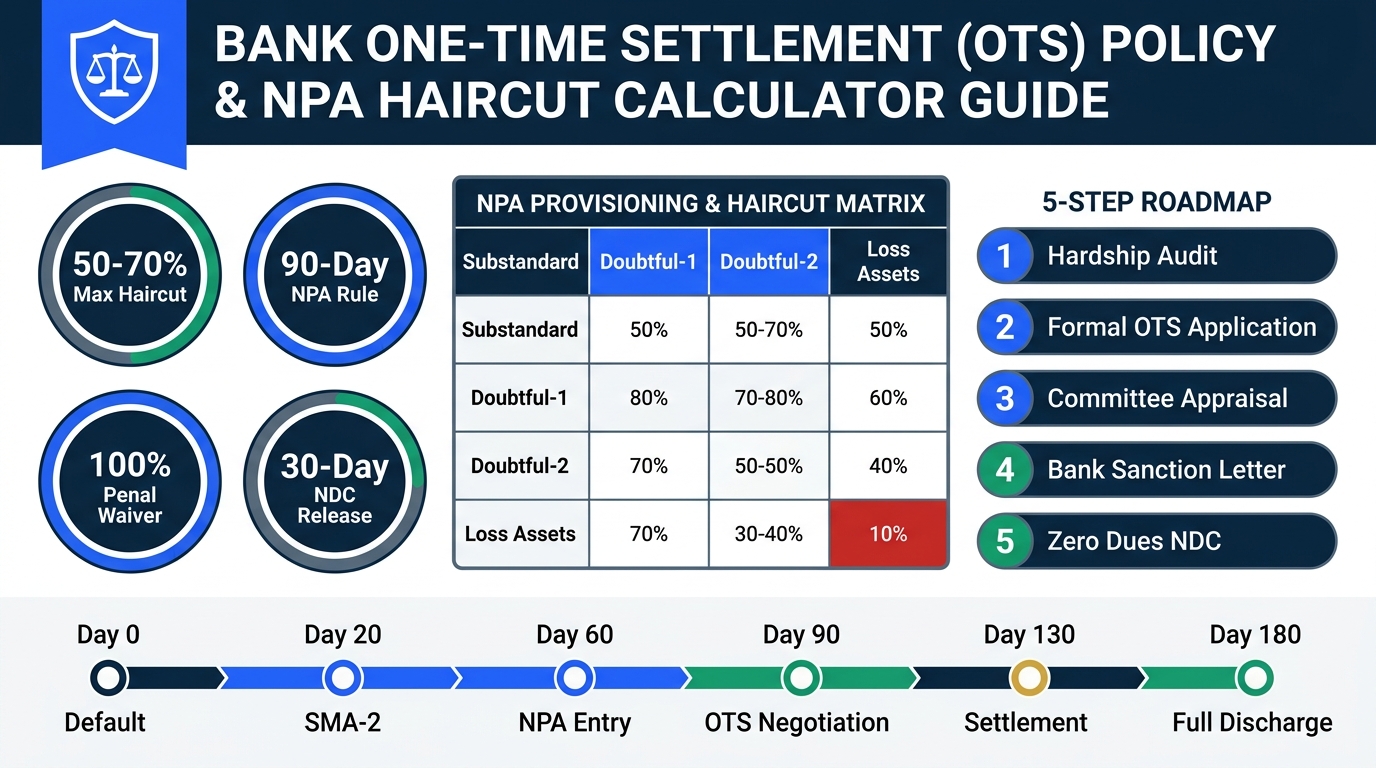
7. Comprehensive Comparison: Bank OTS vs Loan Restructuring vs Lok Adalat vs ARC Assignment
Borrowers facing debt distress often confuse various debt resolution channels. Below is an authoritative legal comparison of the four primary avenues available in India:
| Feature / Dimension | Bank One-Time Settlement (OTS) | Loan Restructuring | Lok Adalat Settlement | Asset Reconstruction (ARC) |
|---|---|---|---|---|
| Core Nature | Lump-sum discount & full debt closure | Tenure extension or EMI reduction | Court-annexed statutory compromise | Bad debt sold to third-party ARC |
| Debt Haircut / Waiver | 35% – 70% of total dues | 0% Haircut (Full principal repaid) | 30% – 60% standardized slabs | 40% – 75% deep compromise |
| Legal Finality | Contractual agreement via bank letter | Modified loan agreement | Civil Court Decree (No appeal) | Assignment agreement with ARC |
| CIBIL Bureau Tag | 'Settled' with ₹0 balance | 'Restructured' (Standard/Substandard) | 'Settled' via Lok Adalat | 'Sold to ARC / Settled' |
| Time to Complete | 30 to 60 Days | 15 to 45 Days | Same-day during session | 60 to 120 Days |
| Best Suited For | Insolvent borrowers with lump-sum help | Temporary cash crunch with steady job | Pre-litigation / pending court disputes | Old, written-off vintage debts |
8. Formal Bank OTS Request Proposal Template (Copyable Format)
Use our production-ready, legally fortified One-Time Settlement proposal template. This draft references the governing RBI Master Directions, establishes involuntary financial hardship, and mandates strict No Dues Certificate protections:
Universal Bank One-Time Settlement (OTS) Proposal Template
Engineered for Commercial Banks, Regional Rural Banks & NBFCs in India
Date: [DD/MM/YYYY]

To,
The Branch Manager,
[Name of the Bank / NBFC, e.g., State Bank of India / HDFC Bank / ICICI Bank / Axis Bank],
[Branch Name and Postal Address],
[City, State, PIN Code]

CC:
1. The Assistant General Manager / Head, Stressed Assets Recovery Branch (SARB), [Bank Name]
2. The Principal Nodal Officer / Grievance Redressal Officer, [Bank Name]

Subject: Formal Application for Compromise One-Time Settlement (OTS) under RBI Master Direction DOR.STR.REC.20/21.04.048/2023-24 — Loan A/C No: [Your Complete Loan Account Number]

Respected Sir / Madam,

1. BORROWER IDENTIFICATION & DISBURSAL PARTICULARS:
I am the primary borrower for the credit facility detailed below, sanctioned and disbursed by your esteemed institution:
- Borrower Full Name: [Your Full Name as per PAN]
- PAN Card Number: [Your 10-digit PAN]
- Loan Account Number: [Loan Account Number]
- Facility Type: [Unsecured Personal Loan / Business Loan / Credit Card / MSME Facility]
- Sanctioned Principal: INR [Original Disbursed Principal Amount]/-
- Disbursal Date: [DD/MM/YYYY]

2. TRACK RECORD OF BONA FIDE REPAYMENT PRIOR TO DEFAULT:
I wish to place on record that I have maintained an unblemished repayment track record from inception, diligently servicing [Number of consecutive EMIs, e.g., 26 EMIs] amounting to an aggregate repayment of INR [Total Repayment Amount Paid]/- prior to encountering involuntary financial insolvency. This confirms my bona fide intent as an honest borrower who has never engaged in willful default or diversion of funds.

3. DETAILS OF GENUINE AND INVOLUNTARY FINANCIAL HARDSHIP:
Commencing from [Month, Year], my financial capacity suffered an unexpected, catastrophic breakdown due to [Specify reason: severe medical emergency requiring prolonged hospitalization / involuntary loss of employment due to corporate downsizing / irreversible commercial losses resulting in enterprise shutdown].
Despite exhaustive personal efforts to liquidate savings and meet living liabilities, my income has been permanently compromised, rendering me completely incapable of servicing the contracted monthly EMIs.

4. STATEMENT OF DUES & SURCHARGE BREAKDOWN:
As per your latest statement of accounts dated [Date], the ledger shows an outstanding book balance of INR [Total Outstanding Book Dues]/-. A substantial portion of this inflated balance consists of compounding penal interest, overdue late levies, bounce charges, and penal interest accrued during the period of financial distress.

5. COMPROMISE ONE-TIME SETTLEMENT (OTS) PROPOSAL:
Pursuant to the Reserve Bank of India (RBI) Master Direction on Compromise Settlements and Technical Write-offs (RBI/2023-24/40 DOR.STR.REC.20/21.04.048/2023-24) and your Board-Approved Compromise Settlement Policy (CSP), I hereby submit a formal compromise settlement offer.

With financial assistance graciously offered by immediate family members solely to resolve this distressed obligation, I offer a full, final, and non-severable settlement amount of:
INR [Proposed Settlement Amount in Figures]/-
(Rupees [Proposed Settlement Amount in Words] Only),
representing [Percentage, e.g., 40%] of the book balance, payable in a single lump-sum tranche within [15 / 30 days] of receiving your formal written OTS Sanction Letter.

6. MANDATORY STATUTORY & BANKING CONDITIONS PRECEDENT:
This compromise settlement proposal is submitted subject to the following standard banking conditions:
a) Complete waiver and permanent extinguishment of all residual principal, unapplied interest, penal interest, legal charges, and late levies upon receipt of the settlement sum.
b) Issuance of a formal OTS Sanction Letter on official bank letterhead signed by an authorized designated signatory, specifying the agreed sum and account closure timeline.
c) Remittance of the settlement amount strictly into the designated loan account via direct banking channels (NEFT/RTGS/Account Payee Cheque).
d) Immediate cessation of all third-party collection agent communication, unannounced home visits, and unconditional withdrawal of any pending civil, arbitration, or Section 138/Section 25 proceedings.
e) Issuance of a comprehensive No Dues Certificate (NDC) and closure certificate within 30 days of payment under RBI Circular RBI/2023-24/60, and updating credit information companies (CIBIL, Experian, Equifax, CRIF) to status 'Settled' with INR 0 balance.

7. ENCLOSURES OF VERIFIABLE HARDSHIP EVIDENCE:
1. Copy of PAN Card & Aadhaar Card.
2. Certified Bank Statements (6 Months) proving severe income reduction.
3. Hardship Documentation: [Attach Medical Records / Termination Letter / P&L Balance Sheets / GST Surrender Certificate].
4. Latest Loan Account Statement.

I humbly request you to place this application before the Competent Credit Committee for sympathetic evaluation and formal sanction at the earliest.

Yours sincerely,

________________________
(Signature)
[Your Full Name]
Contact Mobile: [+91-XXXXXXXXXX]
Email Address: [your.email@example.com]
Residential Address: [Your Full Postal Address]
9. Sanction Letter Audit, Direct Payment Protocol & The RBI 30-Day NDC Mandate
Over 40% of distressed borrowers who attempt settlement independently fall victim to payment traps—transferring money based on phone calls or WhatsApp messages from recovery agents, only to discover later that the bank credited the money towards overdue interest without closing the loan.
| Audit Parameter | Legitimate Bank OTS Sanction Letter | Fraudulent / Unauthorized Recovery Offer |
|---|---|---|
| Issuing Medium | Official printed Bank letterhead with reference code | WhatsApp message, personal Gmail, or generic PDF |
| Authorized Signatory | Chief Manager / AGM / SARB Head with employee ID | Third-party collection agency field supervisor |
| Specific Account No. | Exact 16-digit primary loan account number | Vague customer ID or agency internal reference |
| Waiver & Discharge Clause | Explicitly states balance principal & interest waived | Vaguely mentions 'part payment towards overdue' |
| Remittance Destination | Direct credit to your designated loan account only | Personal UPI ID, cash hand-over, or agency current account |
| NDC Timeline Commitment | Guaranteed No Dues Certificate within 30 days | No written commitment regarding NDC or CIBIL update |
Under RBI Circular RBI/2023-24/60, regulated lenders are mandated to release all original movable/immovable property documents and issue full closure certificates within 30 calendar days of receiving full settlement payment. If the bank fails to release documents within 30 days, it must pay the borrower ₹5,000 for each day of delay as statutory compensation.
10. CIBIL Impact & Credit Score Rehabilitation Post-OTS
A One-Time Settlement successfully eliminates debt and ends all legal risks, but it does carry credit bureau consequences. Understanding this lifecycle ensures realistic financial planning:
'Settled' Tag with ₹0 Balance
Under CICRA 2005, the bank reports the account as 'Settled' rather than 'Closed.' The outstanding balance is updated to ₹0, eliminating active overdue default drag.
Immediate Score Stabilization
While the score experiences a temporary dip (typically 50–100 points), the cessation of compounding monthly 90+ DPD default markers allows the score to stabilize and bottom out.
The Credit Rebuilding Ladder
By acquiring a secured credit card (FD-backed) and servicing small monthly spends on time, borrowers can rebuild their CIBIL score back to 750+ within 18 to 24 months.

Settle Loan is India's trusted debt relief and loan settlement platform. We help borrowers overcome financial distress by negotiating with banks and NBFCs to legally settle personal loans and credit card debts. With our transparent, performance-based approach, you can achieve debt freedom and regain your financial peace of mind.
Media Mentions
COMPUTER
Frequently Asked Questions on Bank One-Time Settlement Policies
Detailed, legally verified answers addressing the most critical operational and legal questions regarding bank OTS negotiations in India.
A Bank One-Time Settlement (OTS) is a legally binding compromise contract between a regulated financial institution (Bank or NBFC) and a distressed borrower. Under this framework, the lender agrees to accept a negotiated lump-sum payment (or structured tranches) that is lower than the total book outstanding, voluntarily waiving the remaining balance, penal interest, and incidental legal fees. Once paid, the loan account is fully extinguished, all legal proceedings are formally withdrawn, and the bank issues a No Dues Certificate (NDC) under board-approved compromise policies framed in compliance with Reserve Bank of India (RBI) Master Directions.
Banks determine the acceptable OTS floor using a Net Present Value (NPV) recovery formula. The Credit Committee evaluates: (1) The realizable value of any underlying security, (2) The projected legal recovery timeframe (typically 3 to 7 years in DRT or Civil Courts), (3) Litigation costs and advocate fees, (4) The discount rate (cost of funds), and (5) The cumulative loan-loss provisioning already allocated against the asset. For unsecured personal loans or credit cards classified as Doubtful (D1/D2/D3) or Loss Assets where 100% provisioning is already recognized on the bank's balance sheet, banks are empowered to accept substantial debt haircuts ranging between 40% and 70%.
Under the RBI Master Direction on Compromise Settlements and Technical Write-offs (DOR.STR.REC.20/21.04.048/2023-24) issued on June 8, 2023, all Commercial Banks, Urban Co-operative Banks, and NBFCs must implement a board-approved Compromise Settlement Policy. The guidelines stipulate: (a) Objective and non-discriminatory criteria for granting concessions, (b) A clear delegation of authority matrix where higher haircuts must be approved by designated senior committees, (c) A minimum cooling-off period of 12 months before a borrower can be granted fresh credit post-settlement, and (d) Mandatory quarterly reporting of all compromise settlements to the bank's Board of Directors.
Banks demonstrate the highest willingness to negotiate once an account has crossed the 90-day overdue threshold and entered Non-Performing Asset (NPA) status. Specifically, accounts in Doubtful-1 (D1: 12–24 months overdue), Doubtful-2 (D2: 24–36 months overdue), or Loss Asset categories receive the most favorable settlement terms. At these stages, the bank has already absorbed heavy balance-sheet provisions (25% to 100%), and recovering immediate liquid cash through an OTS provides a direct write-back to the bank's profit-and-loss statement.
To secure the maximum legal haircut: (1) Establish Involuntary Distress: Compile rock-solid evidence of job loss, medical disability, or business insolvency to disprove willful default; (2) Bypass Low-Level Agents: Never negotiate terms with third-party recovery agents who lack sanctioning authority; (3) Submit a Formal Written OTS Proposal: Address the Branch Manager and Head of Stressed Assets Recovery Branch (SARB) referencing RBI Master Directions; (4) Anchor Your Initial Offer: Start with a realistic proposal of 25% to 35% of book balance to negotiate toward a 40%–55% compromise; (5) Insist on Official Sanction: Never transfer funds until you receive a formal, stamped OTS Sanction Letter on official bank letterhead.
Yes, secured loans can be settled under OTS, but banks offer much smaller haircuts (usually 10% to 25% waiver of penal interest and legal costs) because the bank holds primary mortgage rights under the SARFAESI Act, 2002 to take physical possession and auction the underlying property. Significant haircuts on secured debts are approved only if the collateralized property has severe title defects, valuation shortfalls, structural encumbrances, or is tied up in protracted DRT litigation where recovery costs exceed the realizable security value.
Settlement approval follows the bank's Delegation of Financial Powers (DoFP) matrix. Branch Managers generally possess authority only to waive penal interest up to ₹50,000–₹1 Lakh. Compromise proposals involving principal write-offs for retail, personal, and SME loans are evaluated and sanctioned by the Regional Settlement Committee, Stressed Assets Recovery Branch (SARB) Committee, or Zonal/Board-Level Compromise Committees depending on the total sanctioned exposure.
A Bank OTS is an internal administrative settlement executed directly between the borrower and lender under the bank's compromise policy. A Lok Adalat settlement is a statutory dispute resolution mechanism under the Legal Services Authorities Act, 1987. Lok Adalat awards have the status of a Civil Court decree with finality—no appeal lies against them in any court. Banks frequently offer pre-approved, standardized discount slabs during National Lok Adalat sessions to rapidly clear low-ticket retail NPA portfolios.
Borrowers must adhere to four cardinal security rules: (1) Zero Verbal Payments: Never pay based on phone calls, SMS, or WhatsApp promises from recovery agents; (2) Audit the Sanction Letter: Ensure you hold a physical, stamped OTS approval on official bank letterhead signed by an authorized officer; (3) Verify Direct Credit: Remit payments strictly into your designated loan account number via NEFT/RTGS or account payee draft—never into an individual's account; (4) Explicit Closure Clause: Confirm the letter explicitly states that the agreed sum constitutes full and final satisfaction with zero remaining liability.
Pursuant to RBI Circular RBI/2023-24/60 (Release of Movable/Immovable Property Documents on Repayment/Settlement of Personal Loans), all Regulated Entities must release original property documents and issue a comprehensive No Dues Certificate within 30 calendar days of receiving full settlement remittance. If the bank delays beyond 30 days for reasons attributable to the lender, it is legally mandated to pay compensation to the borrower at the rate of ₹5,000 for each day of delay.
Official Regulatory Sources & Statutory References
- Reserve Bank of India (RBI): Master Direction on Compromise Settlements and Technical Write-offs (RBI/2023-24/40 DOR.STR.REC.20/21.04.048/2023-24)
- RBI Master Circular: Prudential Norms on Income Recognition, Asset Classification and Provisioning (IRACP) pertaining to Advances
- RBI Circular RBI/2023-24/60: Release of Movable/Immovable Property Documents on Repayment/Settlement of Personal Loans & ₹5,000/day Penalty Rules
- RBI Fair Practices Code: Master Circular on Recovery Agents & Code of Conduct for Regulated Entities (RBI/2022-23/108)
- Reserve Bank - Integrated Ombudsman Scheme, 2021: Dispute Redressal Portal for OTS Non-Compliance, Coercive Recovery & NDC Delays