1. Revolving Credit Cards vs. Fixed Term Personal Loans: Structural Differences
Borrowers facing acute liquidity stress in India often carry a toxic combination of unsecured credit cards and personal loans across multiple commercial banks. Understanding the fundamental architectural differences between revolving credit card lines and amortized personal loans is essential for determining your negotiation leverage, projected settlement haircuts, and debt settlement priority.
A personal loan is a closed-end contractual credit facility. The bank disburses a lump sum of raw capital directly into your savings account, which is amortized over a fixed tenure of 12 to 60 months with Equated Monthly Installments (EMIs) calculated on a reducing balance basis at interest rates typically ranging between 11% and 24% per annum. Conversely, a credit card is an open-end revolving credit line. Cardholders borrow against an assigned limit, and if the total balance is not paid within the grace period, finance charges compound monthly at annualized percentage rates (APR) between 42% and 48%, coupled with 18% Goods and Services Tax (GST) on all accrued interest and late payment penalties.
Revolving unsecured credit with monthly compounding finance charges, steep late fees, and rapid balance inflation.
- Interest Mechanism: 3.5%–4.0% per month (42%–48% APR) plus 18% GST compounding on rolling dues.
- Balance Composition: 40%–60% of delinquent statement balance consists of phantom finance fees and penalties.
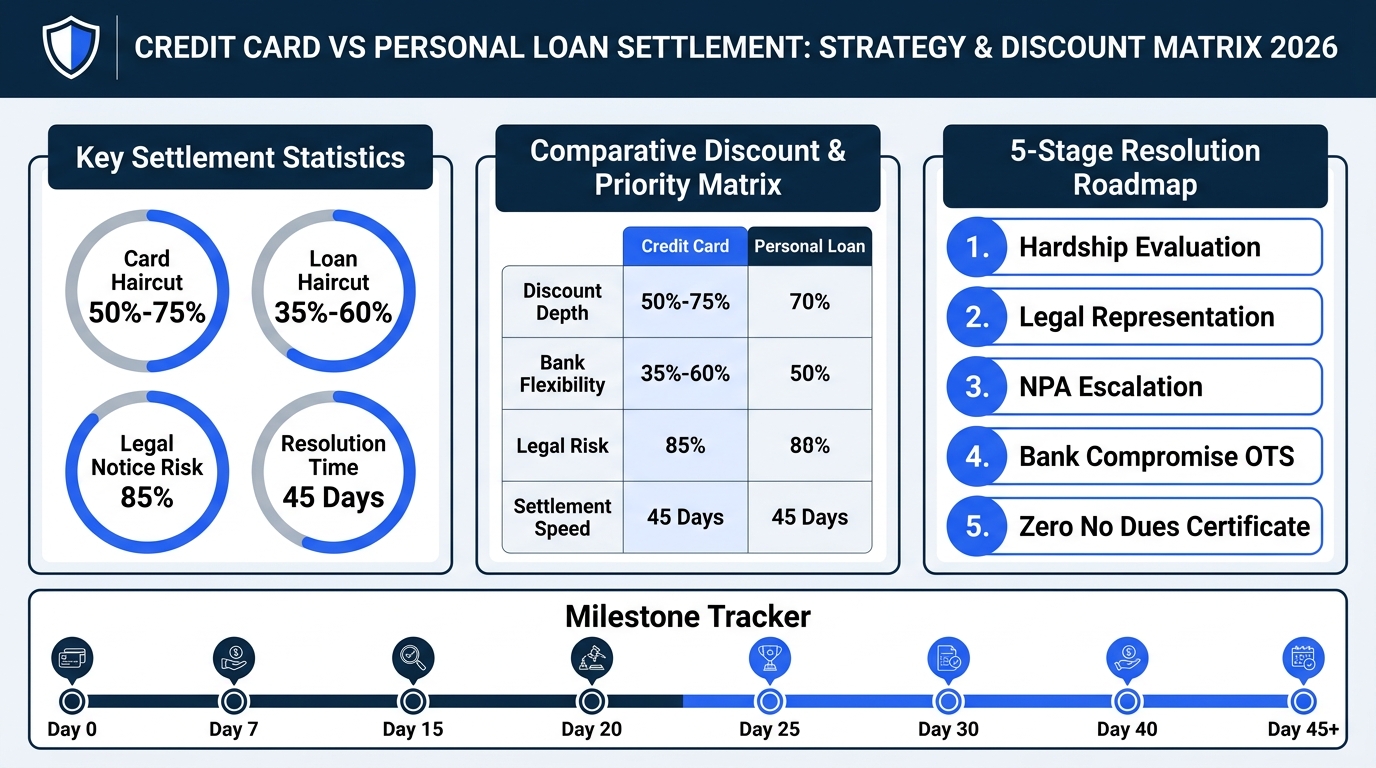
- Settlement Haircut: Typically 50% to 75% discount on total accumulated statement dues.
- Legal Instrument: Electronic cardholder agreement; rarely backed by post-dated cheques or NACH.
Disbursed principal capital with fixed monthly amortization, reducing balance interest, and statutory e-mandates.
- Interest Mechanism: 11%–24% reducing balance APR with fixed contractual EMI schedule.
- Balance Composition: 70%–85% of delinquent balance represents raw disbursed principal capital.
- Settlement Haircut: Typically 35% to 60% discount on outstanding loan principal.
- Legal Instrument: Mandatory signed NACH / e-mandate allowing statutory Section 25/138 notices.
2. Banking Accounting & Provisioning: How Lenders Treat Default
Under the Reserve Bank of India Master Circular on Prudential Norms on Income Recognition, Asset Classification and Provisioning pertaining to Advances (IRACP), scheduled commercial banks and Non-Banking Financial Companies (NBFCs) must follow strict statutory guidelines when classifying delinquent accounts. When a borrower misses payments, both credit cards and personal loans progress through Special Mention Account buckets: SMA-0 (1 to 30 days overdue), SMA-1 (31 to 60 days overdue), and SMA-2 (61 to 90 days overdue). At 90 days past due (DPD), the account is formally classified as a Non-Performing Asset (NPA).
However, internal banking accounting diverges sharply once an account crosses the 90-day NPA threshold. Because credit cards are revolving retail instruments with zero collateral and minimal legal recovery prospects, major private and public sector banks (including HDFC Bank, ICICI Bank, SBI, Axis Bank, and Kotak Mahindra Bank) subject credit cards to aggressive charge-off schedules. By 120 to 180 days of default, credit card balances are categorized as loss assets and 100% provisioned on the bank balance sheet.
Once an asset is 100% provisioned, any recovery achieved through a One-Time Settlement (OTS) is booked directly as clean, immediate non-interest profit. Consequently, bank credit card recovery managers have extensive decentralized mandate powers to authorize deep settlement haircuts without requiring board-level sign-offs. Personal loans, conversely, undergo standard provisioning of 15% to 25% during the sub-standard phase, and retail credit committees enforce stricter floor recovery thresholds to safeguard disbursed principal capital.
3. Settlement Haircut Depth: Why Credit Cards Offer 50%–75% Discounts vs. 35%–60% on Loans
The most critical mathematical reality in Indian debt resolution is that credit card settlements consistently yield substantially larger percentage haircuts than personal loan settlements. This discrepancy is not arbitrary; it is rooted directly in balance composition and bank recovery economics.
When a borrower defaults on a ₹3,00,000 credit card limit for 6 to 9 months, the statement balance rapidly balloons to ₹5,20,000 due to 48% APR compounding, monthly late payment charges of ₹1,200 to ₹1,500, over-limit penalties, and 18% GST. The bank recognizes that ₹2,20,000 of the outstanding total represents artificial accounting interest. When SettleLoans advocates present formal hardship representation, the bank readily waives the entire ₹2,20,000 penalty component, plus an additional 30% to 50% discount on the original ₹3,00,000 principal. This results in an effective 65% to 75% overall haircut from gross statement dues.
Financial Settlement Simulation: ₹5,00,000 Default Balance Comparison
| Financial Parameter | Credit Card Settlement | Personal Loan Settlement |
|---|---|---|
| Original Principal Disbursed / Used | ₹3,10,000 | ₹5,00,000 |
| Accrued Interest & Penal Charges (9 Mos) | ₹1,90,000 (42% APR + GST + Penalties) | ₹65,000 (Contractual EMI Arrears + Bounce Fees) |
| Total Delinquent Dues on Bank Books | ₹5,00,000 | ₹5,65,000 |
| Waiver on Penal Charges & Interest | 100% Waived (-₹1,90,000) | 100% Waived (-₹65,000) |
| Principal Haircut Negotiated by Advocates | 45% Principal Haircut (-₹1,39,500) | 40% Principal Haircut (-₹2,00,000) |
| Final One-Time Settlement (OTS) Amount | ₹1,70,500 | ₹3,00,000 |
| Effective Total Discount Percentage | 65.9% Total Haircut | 46.9% Total Haircut |
| Settlement Approval Authority | Card Unit Zonal Manager (Fast Track: 15–25 Days) | Branch & Credit Committee (Standard: 30–45 Days) |
4. Legal Exposure & Recovery Agency Tactics: Section 138 vs. Civil Debt Recovery
When borrowers default simultaneously on credit cards and personal loans, recovery dynamics and legal exposure differ substantially. Personal loans carry structured statutory enforcement mechanisms because banks mandate pre-authorized National Automated Clearing House (NACH) e-mandates or physical post-dated cheques prior to loan disbursal.
When a personal loan EMI bounces due to insufficient funds, the lender can initiate quasi-criminal proceedings under Section 25 of the Payment and Settlement Systems Act, 2007 (PSS Act) or Section 138 of the Negotiable Instruments Act, 1881. The bank issues a mandatory 30-day statutory demand notice through legal counsel, followed by filing a formal complaint before a Judicial Magistrate. If ignored, the court may issue bailable summons.
In contrast, credit card accounts rarely involve pre-signed cheques or NACH mandates. A default on a credit card constitutes a civil breach of contract rather than a criminal offence. Lenders cannot file Section 138 or Section 25 PSS Act complaints for card defaults unless you issued a physical cheque that subsequently dishonoured. Instead, credit card recovery divisions rely heavily on external collection agencies, pre-litigation Lok Adalat notices, or unilateral arbitration proceedings. Knowing these statutory distinctions is vital for protecting your legal rights under the RBI Fair Practices Code.
5. Strategic Debt Triage: Which Debt Should You Settle First with Limited Cash?
When a borrower holds multiple delinquent credit cards and personal loans but possesses only a limited cash reserve (such as provident fund withdrawal, family assistance, or liquidated gold), deploying those funds without a strategic triage plan leads to catastrophic misallocation. Paying a small amount to every bank satisfies no creditor and leaves you exposed to both legal summons and aggressive collection harassment.
SettleLoans employs a 3-tier triage diagnostic to maximize cash efficiency and extinguish legal liability in strict order of strategic necessity:
Priority 1: Active Statutory Legal Exposure (Personal Loans with Sec 138/25 Notices)
If an NBFC or bank has issued a formal advocate notice under Section 138 of the Negotiable Instruments Act or Section 25 of the PSS Act, this debt must be addressed first. SettleLoans advocates engage the lender recovery division immediately to negotiate a compromise OTS and secure an official withdrawal of court proceedings upon settlement execution.
Priority 2: Deepest Discount Leverage (Charged-Off Credit Cards at 65%–75% Haircut)
Once criminal litigation exposure is neutralized, allocate liquid cash to settled credit cards. Because credit card divisions offer deep 65%–75% discounts on charged-off accounts, a ₹4,00,000 credit card debt can frequently be extinguished for ₹1,20,000 to ₹1,40,000, immediately eliminating high-velocity interest compounding.
Priority 3: Secondary Unsecured Loans & Fintech Digital Credit Lines
Remaining personal loans and digital app lines are placed under formal legal representation under the RBI Fair Practices Code. Advocates maintain communication with lenders, stall coercive collection, and negotiate staggered multi-month OTS terms as new cash reserves accumulate.
6. Net Present Value (NPV) & Risk Modeling: Inside the Bank's Settlement Committee
To negotiate effectively, borrowers must understand how bank recovery committees evaluate settlement proposals. Lenders do not make settlement decisions based on emotional pleas; they utilize Net Present Value (NPV) recovery modeling to assess whether accepting an immediate discounted cash offer yields a higher risk-adjusted return than pursuing protracted legal litigation.
The bank risk committee calculates the expected recovery value of civil litigation using the following discounted cash flow formula:
Where P_success is the probability of recovering funds through court litigation, Legal Costs include advocate retainers and court fees, r represents the bank's cost of capital, and t is the litigation duration in years.
For unsecured credit cards, the probability of recovery through civil courts is exceptionally low (often below 15%), while litigation costs exceed projected recoveries. This mathematical reality creates significant downward pressure on the bank's reserve price, allowing SettleLoans advocates to lock in aggressive OTS terms. For personal loans, while recovery probabilities are moderately higher due to banking relationships, the time value of money and mounting legal costs still compel lenders to accept reasonable compromise settlements.
7. Credit Bureau Reporting & CIBIL Score Trajectory Post-Settlement
Both credit card and personal loan settlements result in a "Settled" or "Post (WO) Settled" status being transmitted to all four RBI-licensed credit information companies in India: TransUnion CIBIL, Experian, Equifax, and CRIF High Mark. While both settlements cause an immediate CIBIL score drop of 75 to 150 points, their structural impact on your ongoing credit profile differs.
When a delinquent credit card is settled, the card account is permanently closed, and the high Credit Utilization Ratio (CUR)—which was previously reported at 120% to 150% of the limit—is eliminated. Removing maxed-out revolving credit balances immediately stops ongoing bureau score erosion. For personal loans, the account is marked with a ₹0 current balance and a closed date, terminating delinquent DPD counters.
Rebuilding your credit profile after settling dual debts requires a structured 24-month protocol. Within 30 to 45 days post-settlement, ensure all lenders issue verified No Dues Certificates. Next, open a fixed-deposit-backed secured credit card (such as an FD card with 90% credit limit) and maintain a strict utilization ratio below 25%, paying all statements in full on time. By following this protocol, borrowers consistently rebuild their CIBIL score back above 750 within 18 to 24 months.
8. Step-by-Step Multi-Debt Settlement Negotiation Protocol
Successfully resolving a multi-lender portfolio requires disciplined execution across five systematic phases to ensure complete legal compliance and authentic bank documentation:
Stop paying minimum amount due (MAD) on credit cards or token EMI amounts on personal loans. Partial payments are consumed entirely by finance charges without reducing principal or advancing settlement discussions. Pool all available cash into a dedicated settlement reserve fund.
Empaneled advocates serve formal hardship notices under RBI compromise guidelines to each lender. Notices establish an anti-harassment shield under the RBI Fair Practices Code, mandating that collection agents cease calling relatives, contacting employers, or visiting residences.
Advocates run simultaneous negotiations. Credit card charge-offs are negotiated for 60%–75% discounts with fast-track card units, while personal loan files are presented to zonal retail credit committees for 40%–60% principal haircuts.
Never deposit settlement funds based on verbal promises or collection agency emails. Advocates authenticate the official bank sanction letter, verifying that it contains the borrower name, loan account number, explicit settlement amount, payment schedule, and an irrevocable ₹0 balance release clause.
Remit settlement funds directly to the lender's designated loan account via RTGS/NEFT or bank portal. Secure the official No Dues Certificate (NDC) within 30 to 45 days, confirming complete legal discharge and initiation of bureau status updates.
9. SettleLoans Multi-Lender Defense Framework & Representation
Managing multi-lender debt negotiations independently while facing aggressive collection agents is intimidating and legally risky. SettleLoans provides a comprehensive institutional defense framework designed to protect your dignity, preserve your rights, and achieve maximum lawful debt reduction.
Our empaneled team of legal advocates represents borrowers across all major public banks, private financial institutions, and NBFCs in India. We handle all direct creditor communications, quash illegal collection harassment through formal statutory notices, draft robust legal responses to Section 138 and Section 25 PSS Act demand notices, and structure compromise agreements that eliminate up to 75% of your total outstanding debt.
With SettleLoans, every settlement is backed by verified bank sanction letters and official ₹0 No Dues Certificates, providing you with a clean financial slate and a roadmap to complete credit recovery.

Settle Loan is India's trusted debt relief and loan settlement platform. We help borrowers overcome financial distress by negotiating with banks and NBFCs to legally settle personal loans and credit card debts. With our transparent, performance-based approach, you can achieve debt freedom and regain your financial peace of mind.
Media Mentions
COMPUTER
Frequently Asked Questions: Credit Card vs Personal Loan Settlement
Clear, authoritative answers to the most common legal, banking, and financial questions regarding multi-debt resolution.
The primary difference lies in the compounding interest structure, bank provisioning autonomy, and haircut depth. Credit card debt consists heavily of high compounding interest (42%–48% APR), late payment penalties, and GST, allowing banks to offer deep discounts of 50% to 75%. Personal loan settlement deals with disbursed fixed capital at lower contractual interest (12%–24%), resulting in typical settlement haircuts of 35% to 60% of outstanding principal.
Credit cards offer larger discounts because after 90 to 180 days of default, banks classify revolving card debt as charged-off loss assets with 100% provisioning. Furthermore, 40% to 60% of accumulated credit card balances often represent accrued finance charges and late fees rather than original disbursed capital, giving bank credit card recovery divisions broader discretionary waiver authority.
If you have limited liquid funds, prioritize settling debts carrying active legal notice exposure (such as Section 138 NI Act or Section 25 PSS Act NACH bounce notices common in personal loans) to eliminate criminal summons risk. If legal risk is equal, prioritize credit card settlement to maximize direct cash savings through 50%–75% discounts and halt aggressive 4% monthly interest compounding.
Yes. Credit card collections are managed by specialized unsecured card recovery units with pre-approved settlement matrix grids. Because card debt is completely revolving and unsecured, banks are eager to recover raw principal quickly. Personal loan settlements require multi-tier branch or zonal risk committee approvals, making them slightly more structured and time-intensive.
Generally no, unless you physically issued a security cheque that subsequently bounced upon presentation. Credit card accounts operate through electronic cardholder agreements rather than post-dated cheques. However, personal loans mandate automated NACH e-mandates, which routinely trigger Section 25 of the Payment and Settlement Systems Act or Section 138 proceedings upon default.
Both credit card and personal loan settlements result in a "Settled" or "Post (WO) Settled" remark on your credit bureau report and an immediate score drop of 75 to 150 points. However, settling credit cards terminates high revolving credit utilization (CUR) reporting, which actually speeds up bureau recovery once a secured credit rebuilding protocol is initiated.
Yes. Professional debt settlement platforms like SettleLoans represent borrowers with multi-lender portfolios simultaneously. Empaneled advocates serve formal hardship representations under RBI Fair Practices Code, halt recovery agent harassment across all accounts, negotiate maximum statutory haircuts, and secure verified ₹0 No Dues Certificates for both cards and loans.
To establish genuine financial distress under RBI compromise settlement guidelines, you need to provide bank account statements showing income loss or cash exhaustion, salary reduction or job termination letters, medical diagnosis/hospitalization bills, business closure proof (GST cancellation/ITR returns), or evidence of dependent family crises.
Yes. Once your financial situation improves in the future, you can approach the original lender, pay the previously waived haircut amount, and request a comprehensive Final No Dues Certificate. Under CICRA regulations, the lender is legally required to update your bureau status from "Settled" to "Closed - Fully Paid".
Statutory References & Official Regulatory Sources
- Reserve Bank of India (RBI): Framework for Compromise Settlements and Technical Write-offs (RBI/2023-24/40 DOR.STR.REC.20/21.04.048/2023-24).
- Reserve Bank of India (RBI): Master Direction on Recovery Agents and Fair Practices Code for Regulated Entities (RBI/2022-23/108).
- Credit Information Companies (Regulation) Act, 2005 (CICRA): Statutory reporting guidelines for TransUnion CIBIL, Experian, CRIF High Mark, and Equifax.
- Negotiable Instruments Act, 1881: Section 138 statutory defense and legal quashing through compromise settlement.
- Payment and Settlement Systems Act, 2007: Section 25 dishonour of electronic fund transfer provisions and dispute remedies.