- Never Ignore Legal Notices: Unanswered demand notices allow lenders to claim deemed admission of debt and secure ex-parte decrees under Order 37 CPC.
- The Crucial 15-Day Statutory Window: Responding formally within 15 calendar days preserves your legal defences and establishes bona fide financial hardship on record.
- Halting Court Proceedings via Advocate Reply: A structured rejoinder challenging unconstitutional compound penalties forces bank litigation panels into out-of-court compromise talks.
- Transitioning from Dispute to OTS: Legal replies pave the way for structured One-Time Settlement (OTS) discounts ranging between 40% and 65% of total outstanding claims.
1. Anatomy of Bank Legal Notices: Differentiating Demand Letters, Advocate Notices, and Court Summons
Jab koi borrower lagatar teen mahine (90 din) tak apne personal loan, credit card, ya business loan ki EMI ka bhugtan nahi kar pata, toh banking accounting standards ke mutabiq uska loan account Non-Performing Asset (NPA) ghoshit kar diya jata hai. NPA classification ke baad bank ki internal collections department se nikal kar file bank ke legal and recovery cell ko handover ki jati hai. Is charan par aamtaur par borrower ke registered address par ek formal document deliver hota hai jise bolchal ki bhasha mein "Bank Ka Legal Notice" kaha jata hai. Lekin kisi bhi defensive kadam ko uthane se pehle yeh samajhna behad zaroori hai ki aapke hath mein jo dastavez hai, uska actual legal nature aur authority kya hai.
Indian banking jurisprudence mein notice mukhya roop se teen alag-alag categories mein aate hain. Pehli category hoti hai Internal Bank Demand Notice, jo bank ke recovery branch manager ya collection head dwara sidhe bank ke letterhead par bheja jata hai. Yeh ek preliminary reminder hota hai jo loan contract ke breach ki soochana deta hai. Doosri category hoti hai Advocate Legal Notice, jo bank ke panel lawyer dwara Bar Council of India ke rules ke tahat formal legal letterhead par dispatch kiya jata hai. Is notice mein Section 138 Negotiable Instruments Act, Section 25 Payment and Settlement Systems Act (PSSA), ya Code of Civil Procedure (CPC) ke tehat litigation shuru karne ki statutory warning di jati hai.
Teesri aur sabse critical category hoti hai Judicial Court Summons. Summons bank dwara nahi, balki Civil Court, Chief Metropolitan Magistrate (CMM), ya Debt Recovery Tribunal (DRT) dwara official court seal aur judge ke signature ke sath issue kiya jata hai. Demand notice aur Advocate notice ka reply postal registered post ke zariye bheja jata hai, jabki Court Summons aane par nirdharit tareekh par adalat mein physically ya advocate ke madhyam se vakalatnama file karke appear hona mandatory hota hai. In teeno dastavezon ke beech ka farq pehchanna aapke defence ka pehla buniyadi adhar hai.
2. Bank Ke Legal Notice Ko Ignore Karna Kyu Khatarnak Hai: Ex-Parte Decrees & Civil Risks
Adhikansh borrowers ghabrahat, financial resources ki kami, ya galatfehmi ke kaaran bank ke legal notice ko daraz mein band karke rakh dete hain ya use puri tarah ignore kar dete hain. Unhe lagta hai ki jab court se bulawa aayega tab dekha jayega. Yeh unke financial aur legal jeevan ki sabse badi bhool sabit hoti hai. Indian legal framework mein legal notice ko ignore karne ke parinam behad gambhir hote hain jo aapke defence ko hamesha ke liye kamzor kar dete hain.
Jab aap 15 ya 30 din ke notice period ke dauran koi formal advocate reply nahi bhejte, toh civil law ke tahat "Doctrine of Acquiescence" aur "Deemed Admission" ka principle trigger ho jata hai. Iska matlab yeh hai ki court yeh assume kar sakti hai ki bank ne notice mein jo outstanding loan amount, penal charges aur interest darshaya hai, aapko uspar koi aapti nahi hai. Jab bank Civil Court mein Order 37 of the Code of Civil Procedure (Summary Suit) file karta hai, toh court notice ki service aur borrower ke maun (silence) ko record par lekar bina extensive trial ke bank ke favour mein ek summary decree pass kar sakti hai.
Iske atirikt, yadi notice cheque bounce (Section 138 NI Act) ya NACH mandate failure (Section 25 PSSA) ke sambandh mein hai, toh notice ka reply na aane par bank turant trial court mein criminal complaint darj kar deta hai. Magistrate court dwara pehle bailable warrant aur lagatar gair-haziri par non-bailable warrant (NBW) jari kiye ja sakte hain. Yadi aap samay par reply bhejte hain, toh aap record par establish karte hain ki default intentional ya fraudulent nahi tha, balki bona fide economic hardship ke kaaran hua tha, jo future litigation mein aapka sabse bada suraksha kavach banta hai.
3. The 15-Day Critical Reply Window: Strategic Timeline & Statutory Procedural Steps
Har advocate legal notice mein aamtaur par 15 calendar days ka samay diya jata hai jismein dues clear karne ya formal reply submit karne ki demand hoti hai. Yeh 15 din ka samay borrower ke liye ek golden strategic window hota hai. Is dauran kiya gaya action yeh nirdharit karta hai ki aane wale mahino mein mamla court ki lambi litigation mein fasega ya bank ke sath table par baithkar peaceful One-Time Settlement (OTS) mein convert hoga.
Is 15-day window ke dauran aapko char mukhya charano par kaam karna hota hai:
Charan 1: Ledger Statement Audit. Apne bank branch se complete loan statement of account mangwayen. Notice mein mangi gayi rakam aur actual ledger statement ke beech ke fark ko calculate karein. Aksar bank recovery panels arbitrarily penal interest, late fees aur legal expenses jodkar claim ko 30% se 50% tak inflate kar dete hain.
Charan 2: Documenting Genuine Financial Hardship. Yadi default job loss, salary deduction, medical emergency, ya business closure ke kaaran hua hai, toh uske supporting documents (jaise termination letter, medical reports, audited balance sheets) arrange karein.
Charan 3: Engaging an Expert Banking Advocate. Kisi specialized debt settlement advocate se contact karein jo Banking Regulation Act, 1949 aur RBI Master Directions ki barikiyon ko samajhta ho.
Charan 4: Formal Dispatch of Registered Rejoinder. Notice ka reply hamesha Registered Post with A.D. ya Speed Post se bank ke authorized panel advocate aur bank ke Zonal Asset Recovery Office dono ko bheja jana chahiye.
4. Bank Accounting Dynamics: NPA Provisioning, Legal Friction, and Net Present Value (NPV)
Banks kyu legal notice bhejte hain aur fir achanak loan settlement ke liye taiyar kyu ho jate hain? Iske peeche banking accounting aur Reserve Bank of India ke prudential provisioning norms ka deep mathematical reality hota hai. Jab koi loan account 90 din se adhik default rehta hai, toh RBI ke Income Recognition and Asset Classification (IRAC) norms ke mutabiq bank ko us loan ke khilaf apni balance sheet mein se 15% se lekar 100% tak provisioning capital reserve ke roop mein alag rakhna padta hai.
Iska matlab yeh hai ki jab tak aapka loan NPA category mein rehta hai, bank ka valuable capital bina kisi interest return ke lock ho jata hai. Yadi bank court litigation (Civil Suit ya DRT) ka rasta chunta hai, toh Indian courts mein final decree aane aur execution petition lagne mein kam se kam 3 se 5 saal ka samay lagta hai. Is dauran bank ko advocate fees, court fees, aur administrative expenses bear karne padte hain. Isiliye, bank ka credit risk committee Net Present Value (NPV) model par evaluation karta hai:
Where C_t represents estimated recoveries, r is the discount rate, and deductions account for 3–5 years of court friction and capital locked in NPA provisions.
Is mathematical formula ke mutabiq, bank ko agle 4 saal mein kharche karke litigation se 100% recover karne ke mukable, aaj bina litigation ke One-Time Settlement (OTS) ke madhyam se 40% se 50% lump sum recover karna balance sheet ke liye adhik profitable lagta hai. Jab aapka advocate formal reply bhejkar trial challenge create karta hai, toh bank is NPV formula ke tahat compromise settlement approval ki disha mein aage badhta hai.
Bank Ka Legal Notice Aane Par Kya Kare: 4-Stage Resolution Blueprint
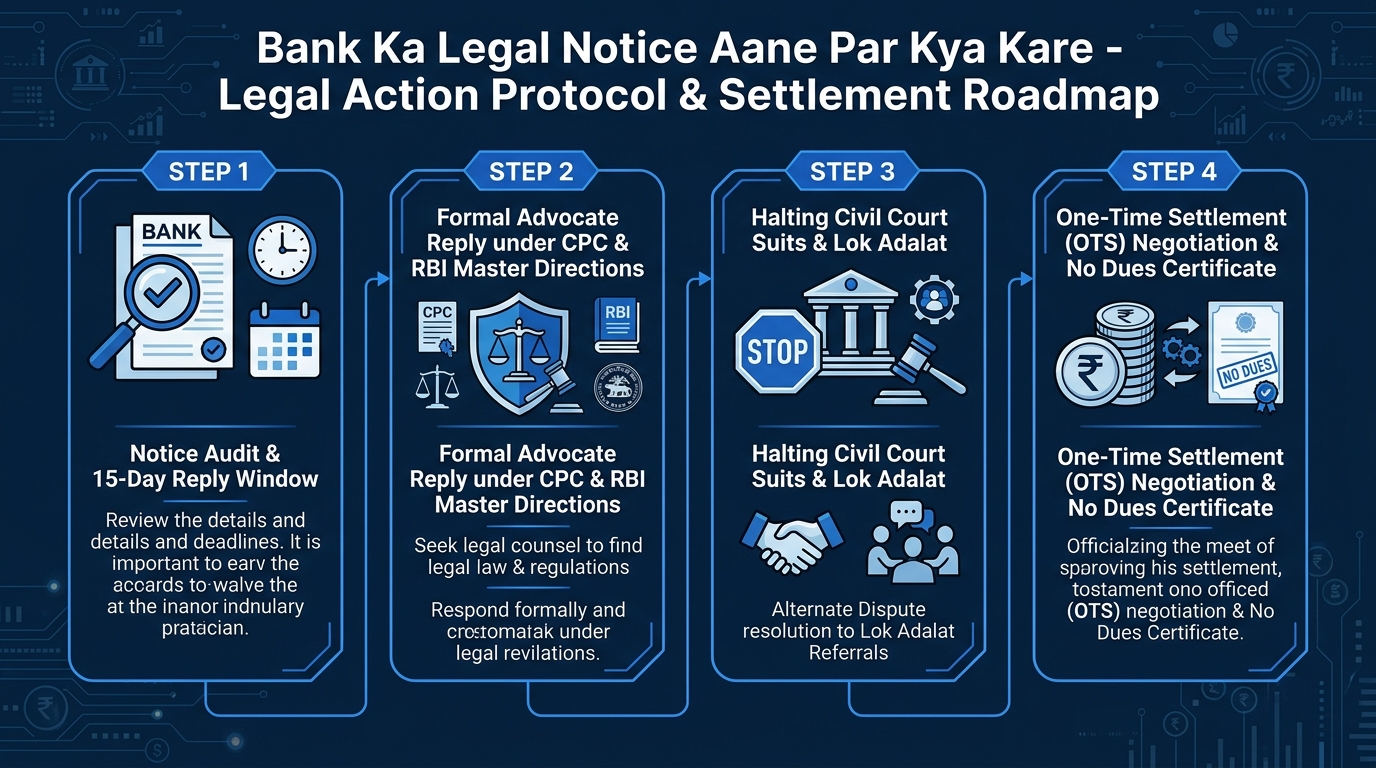
6. Advocate Reply Drafting Strategy: How a Formal Rejoinder Protects Borrowers
Ek professional advocate dwara draft kiya gaya legal notice reply koi simple mafinama ya appeal nahi hota, balki ek comprehensive statutory rejoinder hota hai jo Indian laws aur RBI regulations ke tahat bank ke claims ko structure karta hai. Jab bank ka panel lawyer aapka detailed advocate reply receive karta hai, toh use clear signal milta hai ki borrower legally equipped hai aur bina justifiable ground ke unilateral recovery order lena asambhav hoga.
Ek shaktishali advocate reply mein nimnlikhit char mukhya legal pillars shamil hote hain:
Pillar 1: Challenging Unfair Penal Compound Interest. RBI ke Circular on 'Fair Lending Practice – Penal Charges in Loan Accounts (2024)' ke mutabiq, banks kisi bhi default par penal interest ko compound nahi kar sakte aur na hi ise capitalised debt bana sakte hain. Reply mein bank se complete itemized statement mangwaya jata hai jisse inflated figures legally collapse ho jate hain.
Pillar 2: Recording Bona Fide Hardship & Absence of Mens Rea. Cheque bounce (Section 138 NI Act) ya NACH bounce (Section 25 PSSA) cases mein advocate yeh establish karta hai ki borrower ka koi fraudulent intent ya criminal breach of trust nahi tha, balki default uncontrollable circumstances ke kaaran hua. Yeh evidence court proceedings mein trial defence ka adhar banta hai.
Pillar 3: Demanding Dispute Reconciliation under CPC Section 89. Code of Civil Procedure ke Section 89 ke tahat adalat ko formal appeal ki jati hai ki mamle ko litigation mein lamba kheenchne ke bajaye Alternative Dispute Resolution (ADR) ya Lok Adalat ke madhyam se resolve kiya jaye.
Pillar 4: Documenting Recovery Agent Harassment. Yadi bank ke recovery agents ne call karke dhamkaya hai ya privacy violate ki hai, toh RBI Guidelines on Recovery Agents ke violations ko reply mein record par lakar bank par legal liability fix ki jati hai.
7. Halting Court Proceedings & Alternate Dispute Resolution: National Lok Adalat Mechanism
Legal notice aane ke baad sabse safe aur cost-effective tarika hota hai dispute ko National Lok Adalat ya pre-litigation mediation forum mein shift karna. Legal Services Authorities Act, 1987 ke tahat sthapit Lok Adalat ek statutory forum hai jo courts ke bojh ko kam karne aur borrowers va banks ke beech mutual agreement se disputes ko nipatane ke liye har 3 mahine mein pure desh mein aayojit ki jati hai.
Lok Adalat ke mukhya fayde nimnlikhit hain:
1. Zero Court Fees & Final Decree: Lok Adalat mein settlement hone par koi court fees nahi lagti. Yahan pass hua settlement award ek Civil Court decree ke barabar final hota hai aur iske khilaf koi appeal nahi hoti, jisse future litigation ka khatra hamesha ke liye samapt ho jata hai.
2. Heavy Waiver on Penal Charges: Lok Adalat bench (jismein sitting ya retired judges aur social workers hote hain) banks ko penal interest aur unnecessary charges 100% waive karne ka nirdesh deti hai, jisse settlement amount substantially kam ho jata hai.
3. Immediate Cessation of Harassment: Lok Adalat reference order pass hote hi bank dwara kisi bhi prakar ki third-party collection calling ya physical visits par complete legal stay lag jata hai.
8. One-Time Settlement (OTS) Negotiation: Sanction Letter Forensics & No Dues Certificate
Legal notice ke formal reply ke baad bank jab compromise negotiations ke liye agree hota hai, toh borrower ko One-Time Settlement (OTS) process ko pure forensic discipline ke sath execute karna chahiye. Bahut se borrowers verbally settlement amount tay karke kisi recovery agent ke UPI ya personal account mein paise transfer kar dete hain, jisse unke paise doob jate hain aur bank ledger par default waisa ka waisa bana rehta hai.
Authentic loan settlement execute karne ke teen mandatory golden rules hain:
Niyam 1: Official Bank Stamped Sanction Letter. Kabhi bhi payment tab tak na karein jab tak bank ke Zonal Head ya Competent Authority dwara official letterhead par signed aur stamped OTS Sanction Letter na mil jaye. Is letter mein aapka exact loan account number, sanctioned settlement figure, payment tenure, aur waiver breakdown clearly likha hona chahiye.
Niyam 2: Direct Payment into Loan Account. Settlement amount ka bhugtan hamesha designated loan account number mein direct RTGS/NEFT ya bank branch counter par cheque/draft ke madhyam se hi karein.
Niyam 3: Receipt of No Dues Certificate (NDC). Full payment clear hone ke 21 se 30 dinon ke andar bank se stamped No Dues Certificate (NDC) ya No Objection Certificate (NOC) prapt karein aur ensure karein ki bank CIBIL bureau ko ₹0 balance report kare.
9. Comparative Evaluation: Bank Notice Types, Legal Provisions & Borrower Defence Matrix
Alag-alag banking defaults ke mutabiq alag-alag kanun lagu hote hain. Niche di gayi comparative matrix table aapko har prakar ke bank notice ke legal section, statutory response window, aur effective defence strategy ko spasht roop se samajhati hai:
| Notice Category | Governing Statute | Mandatory Response Window | Consequence If Ignored | Recommended Defence Action |
|---|---|---|---|---|
| Standard Advocate Demand Notice | Indian Contract Act, 1872 & CPC | 15 Calendar Days | Civil Recovery Suit / Order 37 CPC | Advocate Rejoinder challenging penalties & initiating OTS talks |
| Cheque Bounce Notice | Section 138 Negotiable Instruments Act | 15 Days from Receipt | Criminal Complaint & Court Summons | Legal reply proving lack of criminal intent and offering settlement |
| NACH / ECS Bounce Notice | Section 25 Payment & Settlement Systems Act | 15 Days from Receipt | Quasi-Criminal Prosecution under PSSA | Statutory reply highlighting technical mandate errors & hardship |
| Arbitration Notice | Arbitration & Conciliation Act, 1996 | 30 Days (Section 21) | Ex-Parte Arbitral Award & Execution | Object to unilateral arbitrator appointment & shift to Lok Adalat |
| SARFAESI Demand Notice (Secured) | Section 13(2) SARFAESI Act, 2002 | 60 Statutory Days | Section 13(4) Symbolic Asset Possession | File detailed Section 13(3A) objection & DRT Securitisation Appeal |

Settle Loan is India's trusted debt relief and loan settlement platform. We help borrowers overcome financial distress by negotiating with banks and NBFCs to legally settle personal loans and credit card debts. With our transparent, performance-based approach, you can achieve debt freedom and regain your financial peace of mind.
Media Mentions
COMPUTER
Frequently Asked Questions: Bank Legal Notice Resolution & Borrower Protection
Bank ka legal notice aane par sabse pehla kadam kya hona chahiye?
Kya bank legal notice ko ignore karne par police mujhe arrest kar sakti hai?
Legal notice ka reply dene ke liye 15 din ka samay kyu critical hota hai?
Advocate reply court proceedings ko kaise rokta hai?
Kya legal notice ke baad bank ke sath One-Time Settlement (OTS) ho sakta hai?
Demand notice aur Court Summons mein kya antar hota hai?
Kya WhatsApp ya email par aaya legal notice legally valid hota hai?
Bank dwara legal notice mein lagaye gaye penal interest ko kaise challenge karein?
Legal notice ke dauran recovery agents ke harassment se kaise bachein?
- Reserve Bank of India (RBI) – Master Directions on Fair Practices Code & Recovery Norms
- Negotiable Instruments Act, 1881 – Section 138 Cheque Dishonour Statutory Notice Rules
- Payment and Settlement Systems Act, 2007 – Section 25 Electronic Clearance Mandate Rules
- RBI Integrated Ombudsman Scheme – Online Portal for Banking & Recovery Grievances
- National Legal Services Authority (NALSA) – National Lok Adalat Pre-Litigation Settlement Guidelines