The ₹5 Lakh Unsecured Debt Reality: Institutional Banking Risk vs. Borrower Anxiety
In India's retail lending landscape, a ₹5,00,000 personal loan occupies a unique socio-economic position. For salaried professionals and small business owners, an outstanding ₹5 Lakh default triggers intense psychological dread, amplified by relentless collection phone calls, workplace embarrassment threats, and legal notices referencing criminal provisions. Borrowers frequently assume that defaulting on this specific sum will inevitably lead to property attachment or police arrest.
From the institutional accounting perspective of commercial banks and Non-Banking Financial Companies (NBFCs), however, an unsecured ₹5 Lakh exposure represents a manageable retail credit risk governed strictly by statutory Prudential Norms on Income Recognition, Asset Classification and Provisioning (IRACP) established by the Reserve Bank of India. Because an unsecured personal loan lacks underlying collateral, lenders cannot initiate summary asset auctions under the SARFAESI Act, 2002.
Furthermore, because the outstanding balance sits well below the ₹20,00,000 pecuniary jurisdiction threshold required to institute recovery proceedings before the Debt Recovery Tribunal (DRT), the lender's sole judicial recourse is a conventional civil summary suit under Order 37 of the Code of Civil Procedure (CPC). Given that commercial litigation costs and court fees in Indian civil courts regularly exceed 15% to 25% of the claimed debt, banks face a powerful economic incentive to resolve ₹5 Lakh defaults via negotiated compromise settlements.
Delinquency Timeline & RBI NPA Provisioning Dynamics for a ₹5 Lakh Default
When a borrower fails to service consecutive monthly EMIs on a ₹5 Lakh personal loan, the account progresses through tightly structured statutory stages mandated by the RBI Master Framework on Stressed Assets. Understanding this delinquency trajectory is critical, as the bank's willingness to offer deep debt waivers increases proportionally with the aging of the default on its quarterly balance sheet.
| Delinquency Stage | Days Past Due (DPD) | Bank Balance Sheet Provisioning | Primary Bank Action |
|---|---|---|---|
| SMA-0 (Early Alert) | 1 – 30 Days | Standard Provision (0.40%) | Internal automated SMS, IVR calls, and tele-calling follow-ups. |
| SMA-1 (Moderate Stress) | 31 – 60 Days | Standard Provision (0.40%) | Senior branch calls, late fee accruals, and NACH bounce notices. |
| SMA-2 (Imminent Default) | 61 – 90 Days | Standard Provision (0.40%) | Intensive recovery outreach; loan recall demand letter dispatched. |
| Substandard NPA | 91 – 365 Days | Mandatory 25% Unsecured Provision | Outsourced to third-party DRAs; initial OTS compromise discussions. |
| Doubtful / Loss Asset | 365+ Days | 100% Full Balance Sheet Provision | Transferred to SARB; maximum 50%–70% OTS haircut authorization. |
During the early Special Mention Account stages (SMA-0 to SMA-2), the lender treats the default as temporary delinquency, refusing any debt waiver. Once the account crosses 90 Days Past Due, however, the bank must classify the asset as a Non-Performing Asset (NPA) and quarantine a mandatory 25% provisioning charge against its operating profits. Once the default exceeds 12 to 18 months, the bank provisions 100% of the loan amount, effectively recognizing the ₹5 Lakh asset as a total accounting loss. At this juncture, any recovered capital directly boosts the bank's bottom line as write-back profit, paving the way for maximum compromise concessions.
The Mathematical Haircut Formula: Realistic Settlement Slabs for a ₹5,00,000 Loan
A common misconception among distressed borrowers is that loan settlements are arbitrary or based solely on aggressive arguing with field recovery agents. In reality, every institutional settlement in India is governed by the RBI Master Direction on Compromise Settlements and Technical Write-offs (2023). Bank Credit Approval Committees calculate compromise terms using a rigorous Net Present Value (NPV) Recovery Formula:
Statutory Net Present Value (NPV) Valuation Rule
Under RBI compromise guidelines, the settlement amount offered by the borrower must be greater than or equal to the Net Present Value of the estimated net realisable recovery through legal proceedings, discounted at the bank's prevailing base lending rate over a 3-to-5 year litigation horizon minus anticipated judicial expenses.
Because an unsecured ₹5 Lakh personal loan has zero underlying physical collateral to liquidate, the estimated judicial recovery value after accounting for lawyer retainers, court fees, and execution delays is negligible. Consequently, the bank's internal financial model readily validates settlements in the ₹1.50 Lakh to ₹2.50 Lakh range.
| Borrower Circumstance & Default Bucket | Realistic Haircut (%) | Final Settlement Amount | Total Waiver (Waiver of Fees + Principal) |
|---|---|---|---|
| Early NPA (90–120 DPD, Temporary Loss) | 35% – 45% | ₹2,75,000 – ₹3,25,000 | 100% Penal Charges + ₹1.75L–₹2.25L Principal Waiver |
| Substandard NPA (120–240 DPD, Documented Hardship) | 50% – 60% | ₹2,00,000 – ₹2,50,000 | 100% Penal Charges + ₹2.50L–₹3.00L Principal Waiver |
| Deep Default / Doubtful Asset (240–365+ DPD) | 60% – 70% | ₹1,50,000 – ₹2,00,000 | 100% Penal Charges + ₹3.00L–₹3.50L Principal Waiver |
| Catastrophic Hardship (Medical Disability / Insolvency) | 70% – 75% | ₹1,25,000 – ₹1,50,000 | 100% Penal Charges + ₹3.50L–₹3.75L Principal Waiver |
As illustrated above, borrowers who present authentic, verifiable hardship documentation—such as medical discharge summaries, termination letters, or certified balance sheets showing severe revenue collapse—routinely secure 55% to 70% debt waivers, resolving a ₹5,00,000 burden for an affordable lump sum of ₹1.5 to ₹2.25 Lakhs.
Collection Agency Tactics & Recovery Harassment in the ₹5 Lakh Bracket
Why is recovery pressure disproportionately intense for a ₹5 Lakh personal loan default? In Indian retail banking, loan defaults below ₹1 Lakh are frequently written off through automated software protocols, while defaults exceeding ₹25 Lakhs are assigned to institutional litigation departments. The ₹3 Lakh to ₹10 Lakh bracket, therefore, represents the primary revenue engine for empaneled Debt Recovery Agencies (DRAs).
Agency executives operate on performance-based recovery incentives, earning commissions between 10% and 20% on any funds collected. To extract payments, collection agents often deploy coercive techniques that directly violate statutory banking regulations. These include making continuous calls outside permitted hours, threatening home or workplace confrontations, attempting to shame borrowers before employers or neighbors, and contacting personal references scraped from initial loan applications.
Under the RBI Master Circular on Fair Practices Code and the landmark Supreme Court ruling in ICICI Bank Ltd. v. Prakash Kaur (2007), borrowers enjoy comprehensive legal protections. Lenders and their agents are strictly prohibited from using abusive language, visiting workplaces without express consent, contacting borrowers before 08:00 AM or after 07:00 PM, or intimidating family members. Serving a formal advocate cease-and-desist notice halts these tactics immediately by holding bank nodal officers personally accountable.
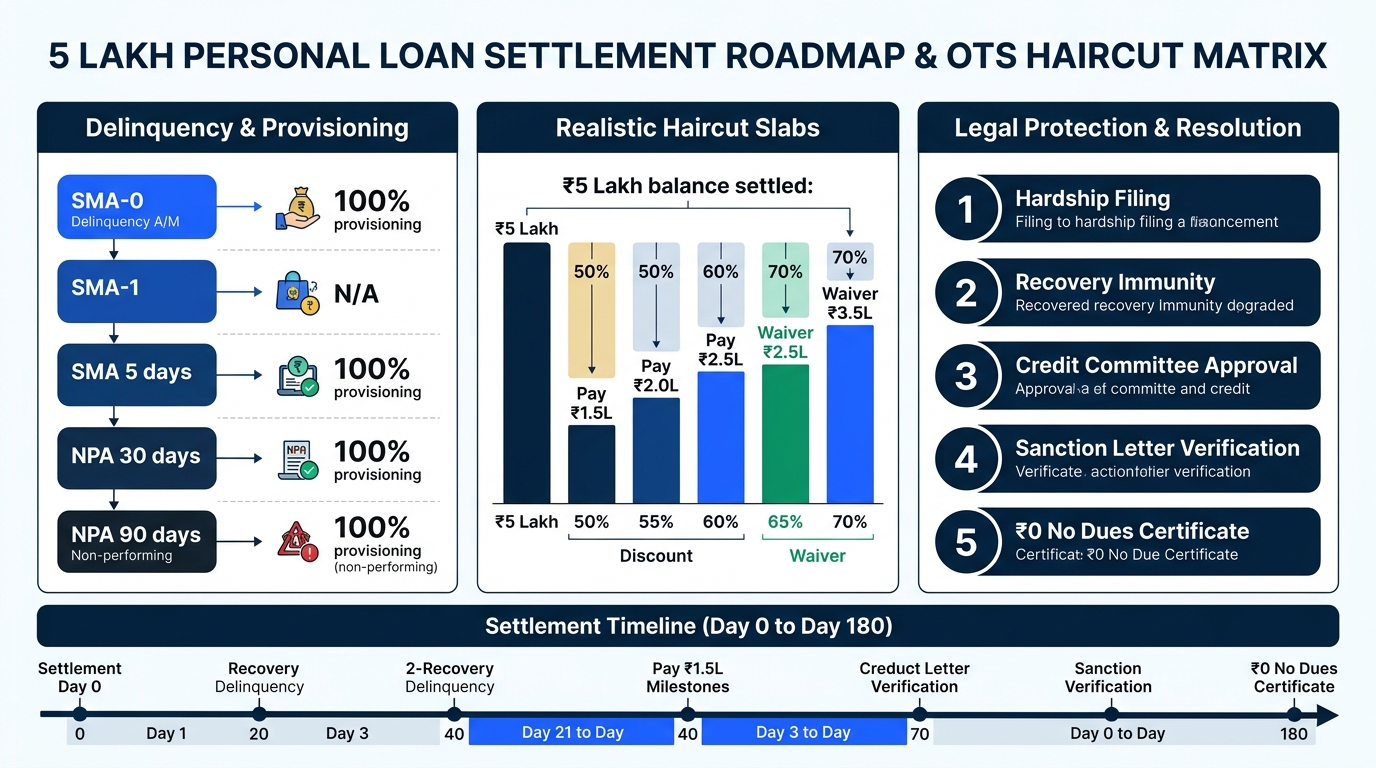
Step-by-Step Strategic Roadmap to Settle a ₹5 Lakh Loan Compromise
Successfully settling an unsecured ₹5 Lakh personal loan requires disciplined execution across five chronological phases, shifting negotiation power from commission-driven recovery agents directly to the bank's Stressed Assets Resolution Branch (SARB) or Zonal Settlement Committee.
The process begins by establishing formal written communication during the 90-to-120 day NPA window. Borrowers must submit a comprehensive Hardship Docket comprising salary slips showing reduced income, medical treatment records, or bank statements proving genuine insolvency. This documentation establishes that the default is a bona fide commercial failure rather than wilful evasion.
Once the Hardship Docket is lodged, all verbal interactions with field agents are redirected to formal written channels. When the bank table an opening settlement offer—typically requesting 70% to 80% of the ledger balance—the borrower submits a reasoned counter-proposal anchored at 30% to 40% of the principal sum. Through iterative rounds over 4 to 8 weeks, consensus is achieved within the realistic 40% to 50% principal bracket (₹2.0L–₹2.5L), backed by an official stamped sanction letter.
Legal Exposure for ₹5 Lakh Defaults: Section 138 NI Act, Section 25 PSSA & Civil Suits
A primary source of anxiety for borrowers defaulting on a ₹5 Lakh loan is the fear of criminal prosecution. It is an immutable principle of Indian jurisprudence that pure financial inability to repay an unsecured debt does not constitute a criminal offence. The police have no statutory authority to register an FIR under Section 420 of the Indian Penal Code (or Section 318 of the Bharatiya Nyaya Sanhita, 2023) unless the lender can demonstrate fraudulent inducement at the inception of the loan.
However, lenders utilize two specific quasi-criminal provisions to exert legal pressure: Section 138 of the Negotiable Instruments Act, 1881 (for dishonoured repayment cheques) and Section 25 of the Payment and Settlement Systems Act, 2007 (PSSA) (for bounced electronic NACH/e-mandates). When an EMI bounces, the bank must issue a statutory 30-day demand notice. If unpaid, a complaint is filed before a Judicial Magistrate.
These quasi-criminal complaints are compoundable offences under Section 147 of the NI Act. When represented by experienced banking counsel, Section 138 and Section 25 proceedings serve as powerful catalysts for compromise settlement. Once an OTS agreement is executed and the settlement amount remitted, the bank is legally bound to withdraw all court complaints, granting the borrower complete civil and criminal immunity.
Bilateral OTS vs. National Lok Adalat vs. Loan Restructuring for ₹5 Lakh Exposure
Borrowers struggling with a ₹5 Lakh default have three distinct legal mechanisms available for resolving their debt obligations. Choosing the optimal avenue depends on current liquidity, future income stability, and immediate legal exposure.
| Resolution Pathway | Typical Debt Waiver (%) | Legal Finality & Judicial Status | Ideal Borrower Profile |
|---|---|---|---|
| Bilateral Bank OTS | 50% – 70% Principal + 100% Fees | Contractual Settlement via Bank Sanction Letter | Borrowers with lump-sum liquidity (₹1.5L–₹2.5L) seeking rapid closure. |
| National Lok Adalat | 45% – 65% Principal + 100% Fees | Civil Court Decree (No appeal lies under Section 21 NALSA) | Borrowers with active court notices or pending Section 138 complaints. |
| Loan Restructuring / Rescheduling | 0% (Tenure extended, EMI reduced) | Modified Loan Agreement with regular interest accruals | Borrowers with restored steady income wishing to preserve credit score. |
While loan restructuring preserves your credit rating by avoiding a 'Settled' remark, it substantially increases your total interest payout over an extended 5-to-7 year tenure. For borrowers experiencing permanent income disruption, a Bilateral OTS or Lok Adalat compromise provides immediate debt extinguishment at a fraction of the original ₹5 Lakh obligation.
The OTS Sanction Letter Audit: Mandatory Clauses & The ₹0 NDC Mandate
A critical vulnerability in retail loan settlements is making payments based on fraudulent or unauthorized assurances from collection executives. Over 30% of individual disputes arise when a borrower pays money into an account based on verbal promises, only to find the bank applied the funds toward partial overdue interest while keeping the ₹5 Lakh loan active.
To guarantee legal finality, the borrower must insist on an authentic OTS Sanction Letter issued on official bank letterhead bearing the physical or digital signature of an authorized signatory (Manager, AVP, or SARB Head) along with the branch stamp. The letter must unambiguously state the negotiated settlement figure, specify the exact payment due dates, and confirm that all remaining dues stand waived upon receipt.
Furthermore, under RBI Circular RBI/2023-24/60, the lending institution is legally mandated to issue a formal ₹0 No Dues Certificate (NDC) / Loan Closure Certificate within 30 calendar days of receiving the final settlement tranche. Any failure or delay by the bank incurs statutory compensation of ₹5,000 per day payable directly to the borrower.
CIBIL Score Impact & 24-Month Credit Rebuilding Blueprint Post-Settlement
Following the execution of a compromise settlement on a ₹5 Lakh personal loan, the lending institution updates the four RBI-licensed credit bureaus (TransUnion CIBIL, Experian, Equifax, and CRIF High Mark), replacing the delinquent status with a 'Settled' remark and setting the outstanding balance to exactly ₹0.
While a 'Settled' tag causes an immediate CIBIL score drop of 75 to 150 points and triggers a mandatory 12-month cooling-off window under RBI rules, it permanently stops the severe month-on-month credit degradation caused by compounding unpaid DPD counters. Eliminating the active default status is the foundational prerequisite for rebuilding financial health.
Rebuilding a credit profile post-settlement is a predictable, systematic process. By opening a fixed deposit of ₹20,000 to ₹50,000 to secure a collateralized credit card, maintaining monthly credit utilization strictly under 25%, and repaying all statement balances punctually on the due date, borrowers routinely elevate their CIBIL score back above 750+ within 18 to 24 months, regaining full eligibility for home loans and vehicle financing.
Why Distressed Borrowers Choose SettleLoans for ₹5 Lakh Loan Resolution
Negotiating an equitable compromise settlement on a ₹5 Lakh personal loan requires seasoned banking litigation counsel. The legal advocates and debt strategists at SettleLoans provide comprehensive protection: issuing immediate cease-and-desist notices to halt collection agent harassment, auditing bank provisioning buckets, and negotiating directly with Zonal Credit Committees to secure the highest permissible debt waiver under RBI frameworks.

Settle Loan is India's trusted debt relief and loan settlement platform. We help borrowers overcome financial distress by negotiating with banks and NBFCs to legally settle personal loans and credit card debts. With our transparent, performance-based approach, you can achieve debt freedom and regain your financial peace of mind.
Media Mentions
COMPUTER
Frequently Asked Questions About Settling a ₹5 Lakh Personal Loan
For an unsecured ₹5 Lakh personal loan in deep default (over 120 to 180 days past due), realistic One-Time Settlement (OTS) amounts typically range between ₹1.5 Lakhs and ₹2.5 Lakhs, representing a substantial 50% to 70% debt haircut. In virtually all approved compromise settlements executed under RBI frameworks, 100% of penal interest, late payment surcharges, and cheque bounce penalties are waived outright, while the core principal is discounted based on documented financial insolvency.
A standard ₹5 Lakh personal loan settlement takes between 3 to 6 months from the date of the first missed EMI. The loan transitions through Special Mention Account stages (SMA-0, SMA-1, and SMA-2) before being classified as a Non-Performing Asset (NPA) at 90 days. The sweet spot for negotiating maximum debt waivers occurs between Day 120 and Day 180, when the lending institution has absorbed balance-sheet provisioning allocations and internal credit committees are authorized to sanction deep compromise settlements.
No. Defaulting on an unsecured personal loan is strictly a civil matter governed by the Indian Contract Act, 1872. The police possess zero legal jurisdiction to register an FIR, arrest you, or summon you to a police station for genuine financial default. However, if repayment cheques bounce or automated NACH mandates fail due to insufficient funds, the lender can file statutory complaints under Section 138 of the Negotiable Instruments Act or Section 25 of the PSSA in a Magistrate Court, which can be resolved through legal representation and compromise settlement.
The ₹5 Lakh bracket represents an intense operational recovery zone for banks and NBFCs. Because the debt is below the ₹20 Lakh threshold required to approach the Debt Recovery Tribunal (DRT), and filing a full civil summary suit incurs substantial legal expenses, financial institutions outsource these accounts to third-party Debt Recovery Agencies (DRAs) on lucrative commission structures (10% to 20% of recovered cash). This economic incentive drives aggressive calling and unauthorized visits, which can be immediately halted by invoking the RBI Master Directions on Recovery Agents (2022).
Under the legal doctrine of Banker's Right of General Lien and Set-Off (Section 171 of the Indian Contract Act), a lender can only deduct funds from accounts held within the same banking institution under the same PAN/CIF. They have no legal authority to attach or debit salary accounts maintained with other independent banks, nor can they seize your residential home, vehicle, or personal belongings without obtaining a formal attachment decree through lengthy civil court proceedings.
Yes. National Lok Adalats organized quarterly by District Legal Services Authorities (DLSA) under the Legal Services Authorities Act, 1987, provide an outstanding legal avenue for resolving ₹5 Lakh loan disputes. Banks participate with pre-approved settlement discount mandates (frequently offering 45% to 65% waivers). The award issued by the Lok Adalat bench holds the status of a final Civil Court Decree with zero court fees, ensuring absolute closure with no right of appeal.
Borrowers must verify five non-negotiable elements: (1) The letter must be printed on official bank letterhead with an authorized officer's signature and branch seal; (2) Your exact loan account number and full name must be accurately stated; (3) The negotiated settlement sum and payment schedule must match precisely; (4) The letter must contain a clear clause stating that upon payment, all residual claims stand fully extinguished; and (5) The letter must guarantee the issuance of a ₹0 No Dues Certificate within 30 days. Never pay based on WhatsApp messages or oral promises.
Following settlement, the bank updates the credit bureaus (CIBIL, Experian, Equifax, CRIF) to 'Settled' with an outstanding balance of ₹0. This entry leads to an immediate credit score dip of 75 to 150 points and triggers a mandatory 12-month cooling period under RBI directives. However, settling stops compounding default penalties and allows you to systematically rebuild your credit score back to 750+ within 18 to 24 months using a secured credit card backed by a fixed deposit.
Such conduct is a direct violation of the RBI Master Directions on Recovery Agents (2022) and the Fair Practices Code. You should document all interactions, demand the recovery agent's DRA certification and bank authorization letter, serve a formal legal cease-and-desist notice through an advocate, escalate the matter to the bank's Principal Nodal Officer (PNO), and lodge an official grievance on the RBI Integrated Ombudsman portal (cms.rbi.org.in).
Official Regulatory References & Statutory Frameworks
- Reserve Bank of India (RBI): Master Direction on Compromise Settlements and Technical Write-offs (DOR.STR.REC.20/21.04.048/2023-24)
- RBI Master Circular: Fair Practices Code for Regulated Entities & Code of Conduct for Direct Recovery Agents
- Reserve Bank - Integrated Ombudsman Scheme, 2021: Official Portal for Coercive Recovery & Settlement Non-Compliance Grievances
- National Legal Services Authority (NALSA): Legal Services Authorities Act, 1987 — National Lok Adalat Dispute Settlement Framework
- TransUnion CIBIL Limited: Credit Information Companies (Regulation) Act, 2005 — Loan Closure & Settlement Reporting Norms