SBI's Retail Credit Architecture & Public Sector Accountability
State Bank of India (SBI) is India's largest public sector lender, managing over a quarter of domestic consumer credit. Its unsecured portfolio—spanning SBI Xpress Credit for salaried personnel, Quick Personal Loans, and Pension Loans—is underwritten against strict employment stability benchmarks. When economic hardship disrupts repayments, borrowers encounter a dispute resolution framework fundamentally distinct from private banking institutions.
As a statutory corporation governed by the State Bank of India Act, 1955, SBI manages public funds under constant scrutiny from the Central Vigilance Commission (CVC) and the Comptroller and Auditor General (CAG). While private bank managers possess broad commercial latitude to grant arbitrary haircuts, SBI officers face personal disciplinary liability for unjustified debt write-offs. Consequently, SBI settlements must adhere strictly to board-approved compromise circulars like the Rin Samadhan Scheme or statutory conciliation before the National Lok Adalat.
SBI Default Progression: From SMA-0 to SARB Branch Decentralization
When an EMI bounces, SBI's core banking platform triggers automated delinquency tracking under RBI Income Recognition and Asset Classification (IRACP) norms. Unsecured retail loans progress through five regulatory tiers that govern provisioning allocations, administrative transfer to specialized recovery branches, and settlement viability.
During the first 90 days (SMA-0/1/2), the loan remains with the home branch. Beyond 90 days, the account is declared a Non-Performing Asset (NPA) and moved to the Retail Assets Central Processing Centre (RACC) or Stressed Assets Recovery Branch (SARB).
| Delinquency Stage | Overdue Aging (DPD) | SBI Administrative Action | Provisioning Impact | OTS Haircut Viability |
|---|---|---|---|---|
| SMA-0 / SMA-1 | 1 – 60 Days | Automated SMS reminders, tele-calls, 2% penal interest levy. | Standard asset; 0% provisioning. | Very Low (Restructuring only). |
| SMA-2 (Pre-NPA) | 61 – 90 Days | Pre-NPA recall notices dispatched; branch loan follow-up. | Flagged for non-accrual. | Low (Interest waiver possible). |
| Substandard NPA | 91 – 365 Days | Declared NPA; file transferred from home branch to SARB/RACC. | 15% mandatory provisioning. | High (35%–50% Haircut). |
| Doubtful (D1/D2/D3) | 1 – 3+ Years | Managed by SARB legal cells; Lok Adalat & DRT referral. | 100% balance-sheet provisioning. | Maximum (50%–65% Haircut). |
SARB transfer marks the ideal window for compromise. Because SBI absorbs 100% provisioning on Doubtful assets, recovering 35% to 50% principal provides immediate balance-sheet recovery.
The SBI Rin Samadhan Scheme & NPA Haircut Calculation Formula
The SBI Rin Samadhan Scheme is State Bank of India's institutional compromise framework designed to resolve stressed retail assets through non-discretionary mathematical formulas. The bank segregates the total debt into the Real Ledger Principal (unrecovered principal plus regular interest up to the NPA date) and Memorandum Dues (unaccrued penal interest and late fees accumulated post-NPA).
SBI Rin Samadhan Haircut Formula
100% Waiver: Penal Interest + Memorandum Interest + Late Charges = ₹0
For example, on an ₹8,00,000 loan ballooned to ₹13,50,000 via penal charges, the ₹5,50,000 memorandum dues are waived 100%. The 40%–65% haircut applies solely to the ₹8,00,000 principal, yielding a ₹2,80,000 to ₹4,80,000 settlement.
| Exposure Tier | Approval Authority | Principal Haircut Range | Memorandum Dues Waiver |
|---|---|---|---|
| Up to ₹5,00,000 | Chief Manager / AGM (SARB) | 35% – 50% Principal Waiver | 100% Fully Waived |
| ₹5,00,001 to ₹20,00,000 | DGM Settlement Committee | 40% – 60% Principal Waiver | 100% Fully Waived |
| Above ₹20,00,000 | GM / CGM Credit Committee | 45% – 65% Principal Waiver | 100% Fully Waived |
Section 171 Banker's Lien & Ringfencing Protected Assets
Under Section 171 of the Indian Contract Act, 1872 (Banker's Right of General Lien and Set-Off), SBI can unilaterally debit funds from any savings account, fixed deposit, or recurring deposit held within SBI under the same CIF/PAN to adjust delinquent loan arrears without prior court approval.
To protect living expenses, borrowers should route income to an independent account at another bank. SBI cannot freeze external accounts without a court decree.
SBI Personal Loan Settlement: Visual Roadmap & Milestones
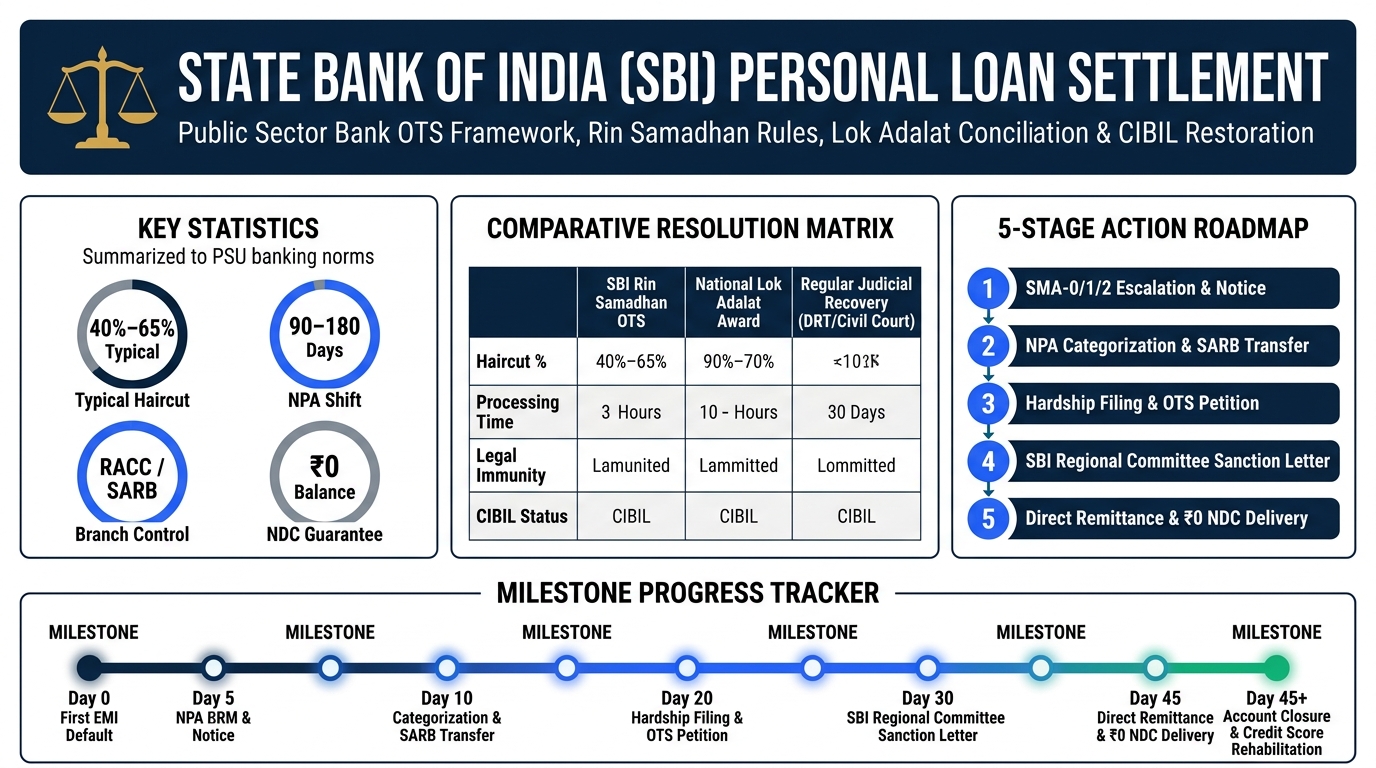
The visual framework below summarizes the end-to-end SBI settlement workflow, comparing resolution channels, key metrics, and resolution timelines from Day 0 default to credit repair.
Why State Bank of India Heavily Favors the National Lok Adalat
SBI is the largest institutional participant in the National Lok Adalat, organized quarterly across India by NALSA under the Legal Services Authorities Act, 1987. SBI prefers Lok Adalat because a compromise award passed by a Lok Adalat bench holds the status of a binding Civil Court Decree under Section 21 with zero right of appeal.
This decree provides total immunity to SBI officials against CVC probes or CAG queries. SBI empowers Lok Adalat representatives with pre-approved 45%–65% discount mandates and disposes of pending Section 25 PSS / Section 138 NI cases upon settlement.
| Resolution Channel | Legal Status | Officer Vigilance Protection | Haircut Flexibility | Summons Disposal |
|---|---|---|---|---|
| National Lok Adalat | Binding Civil Decree | 100% Total Immunity | 45% – 65% (Pre-approved) | Instant automatic disposal |
| In-Branch OTS | Private contract | Subject to CVC audit | 35% – 50% (Strict bands) | Requires separate withdrawal |
| Civil Recovery Suit | Contested trial | Audited litigation | 0% (Full claim + costs) | Protracted court trial |
Defending Against SBI Legal Notices: Section 25 PSS Act & DRT Claims
When an unsecured loan defaults, SBI initiates legal recovery through statutory channels. When electronic NACH mandates fail, SBI issues demand notices under Section 25 of the Payment and Settlement Systems Act, 2007 (PSS Act), followed by magistrate summons if unpaid. Similarly, bounced physical repayment cheques trigger Section 138 of the Negotiable Instruments Act, 1881.
Both Section 25 PSS and Section 138 NI offenses are bailable, compoundable, and strictly financial in nature. An advocate can represent you, secure bail, and seek referral to Lok Adalat for conciliation. Furthermore, SBI cannot file before the Debt Recovery Tribunal (DRT) under the RDB Act unless total exposure exceeds ₹20 Lakhs, and the SARFAESI Act cannot be applied to unsecured personal loans. Under RBI's 2022 Recovery Agent Directives, all agent harassment, abusive calls, or unauthorized workplace visits are strictly illegal.
5-Stage Roadmap: Negotiating SBI Settlement Online & In-Branch
1. Audit NPA Bucket & Identify File Location (Home Branch vs SARB)
Obtain a certified Statement of Account. Separate the actual principal outstanding from unaccrued memorandum penal charges and confirm whether your file is managed by the home branch or regional SARB recovery cell.
2. Assemble an Incontrovertible Hardship Dossier
Document genuine insolvency through termination letters, medical summaries, salary reductions, and bank statements. Solid proof provides SBI committee officers the regulatory justification required to approve maximum haircuts.
3. Submit Formal OTS Petition via Rin Samadhan Portal or SARB
Submit the One-Time Settlement application directly to the Assistant General Manager (AGM) at SARB or through SBI's online OTS portal, proposing an initial settlement between 35% and 50% of the principal balance payable within 30 days.
4. Technical Audit of Official Stamped Sanction Letter
Verify the sanction letter on official SBI stationery with the branch code, committee reference number, and authorized officer signature with HRMS ID before releasing any payment.
5. Direct Loan Account Remittance & Securing ₹0 NDC
Remit the compromise amount directly into your designated SBI Loan Account Number via RTGS/NEFT. Under RBI Circular RBI/2023-24/60, SBI must issue your formal No Dues Certificate within 30 calendar days.
Sanction Letter Audit Checklist & Statutory ₹0 NDC Mandate
Never pay against verbal assurances or agent letters. Payments made without a validated sanction are treated as routine interest part-payments, leaving the default active.
| Checklist Element | Mandatory Verification | Legal Impact |
|---|---|---|
| Official Letterhead | Original SBI stationery with branch code & SARB address. | Prevents forged documents from third-party agents. |
| Officer Credentials | Signed by AGM/DGM/BM with official HRMS employee code. | Confirms delegated financial approval power. |
| Extinguishment Clause | Explicit clause confirming full debt discharge upon payment. | Bars any future residual claims by the bank. |
| Direct Account Routing | Payment routed strictly into designated SBI loan account. | Guarantees immediate ledger balance reduction. |
Pursuant to RBI Circular RBI/2023-24/60, SBI is legally required to complete full loan closure and issue an official No Dues Certificate (NDC) within 30 calendar days. For every day of operational delay beyond 30 days, SBI must pay statutory compensation of ₹5,00,000 / ₹5,000 per day directly to the borrower.
CIBIL Score Trajectory & Credit Rehabilitation Post-Settlement
Following full settlement payment, SBI updates credit bureaus (TransUnion CIBIL, Experian, Equifax, CRIF High Mark) to 'Settled' or 'Post-Write-Off Settled' with an outstanding balance of exactly ₹0. This causes an initial credit score drop of 75 to 150 points, alongside a mandatory 12-month cooling period under RBI directives before fresh unsecured credit can be obtained.
However, a 'Settled' status with ₹0 balance permanently arrests compounding default penalties. By obtaining a secured credit card backed by a fixed deposit, keeping credit utilization strictly below 25%, and maintaining punctual repayments, borrowers routinely rebuild their CIBIL score back above 750+ within 18 to 24 months.
Why Distressed SBI Borrowers Choose SettleLoans
Negotiating with State Bank of India requires seasoned banking advocates who understand CVC regulations, SARB committee powers, and Lok Adalat conciliation. SettleLoans halts recovery harassment, audits NPA provisioning, and negotiates directly with SBI decision-makers to achieve maximum legal debt waivers.

Settle Loan is India's trusted debt relief and loan settlement platform. We help borrowers overcome financial distress by negotiating with banks and NBFCs to legally settle personal loans and credit card debts. With our transparent, performance-based approach, you can achieve debt freedom and regain your financial peace of mind.
Media Mentions
COMPUTER
Frequently Asked Questions About SBI Personal Loan Settlement
The SBI personal loan settlement process is a formal compromise resolution between State Bank of India and a distressed borrower unable to repay unsecured credit like SBI Xpress Credit. Once an account defaults beyond 90 to 180 days and enters Non-Performing Asset (NPA) status, the borrower applies through SBI's online OTS portal (Rin Samadhan or YONO) or submits a formal petition to the Stressed Assets Recovery Branch (SARB). SBI evaluates the proposal against board-approved compromise policies and Net Present Value (NPV) benchmarks. Upon committee sanction, an official stamped OTS Sanction Letter is issued, and upon direct remittance into the loan account, SBI issues a ₹0 No Dues Certificate (NDC).
The SBI Rin Samadhan Scheme is State Bank of India's board-approved One-Time Settlement framework formulated under RBI compromise guidelines. It provides standardized, non-discretionary debt relief to borrowers whose loans are classified as Substandard, Doubtful (D1/D2/D3), or Loss Assets. To qualify, borrowers must demonstrate genuine involuntary hardship—such as job termination, critical illness, or business failure. Wilful defaulters and fraud accounts are strictly excluded under Central Vigilance Commission (CVC) rules. The scheme offers structured principal haircuts (40%–65%) and 100% waiver of unaccrued penal interest.
Unlike private sector lenders where credit managers have broad commercial discretion to negotiate case-by-case waivers, SBI is a Public Sector Undertaking (PSU) governed by the State Bank of India Act, 1955. Every rupee waived is public money subject to statutory audit by the Central Vigilance Commission (CVC) and the Comptroller and Auditor General (CAG). To protect bank officers from vigilance inquiries, all SBI debt concessions must adhere strictly to board-approved settlement circulars or judicial conciliation forums like the National Lok Adalat.
On unsecured personal loans and Xpress Credit facilities, SBI typically approves debt haircuts between 40% and 65% of the outstanding ledger principal. Accounts in Doubtful (D2/D3) or Loss Asset categories—where SBI has already provisioned 100% against the debt on its balance sheet—attract the highest discounts. Early Substandard NPAs qualify for 30% to 45% waivers. In all approved compromise settlements, 100% of accumulated penal interest, overdue charges, and unaccrued memorandum interest are completely eliminated.
Under the Banker's Right of General Lien and Set-Off (Section 171 of the Indian Contract Act, 1872), SBI has the legal power to debit funds from any savings account, fixed deposit, or recurring deposit held within SBI under the same CIF/PAN to adjust overdue loan dues. However, SBI cannot access or debit accounts held with other independent banks (such as HDFC, ICICI, or PNB) without an explicit Civil Court or DRT attachment order. Furthermore, statutory pensions and PPF balances enjoy absolute immunity under Section 60 of the Code of Civil Procedure (CPC).
SBI actively participates in the National Lok Adalat under the Legal Services Authorities Act, 1987 because a Lok Adalat compromise award carries the status of a binding Civil Court Decree under Section 21. No appeal lies against a Lok Adalat decree in any court. This judicial finality provides total immunity to SBI officials against future vigilance probes or audit queries, enabling the bank to deploy its highest pre-approved discount mandates (45% to 65% haircut) with rapid account closure.
Defaulting on an unsecured personal loan is strictly a civil breach of contract and cannot result in police arrest or criminal FIRs. However, SBI can initiate statutory recovery actions: (1) Section 25 of the Payment and Settlement Systems Act, 2007 for NACH/e-mandate dishonor; (2) Section 138 of the Negotiable Instruments Act, 1881 for bounced cheques; (3) Summary Civil Suits under Order 37 CPC; and (4) Debt Recovery Tribunal (DRT) claims if total aggregate exposure exceeds ₹20 Lakhs. All these notices can be resolved through formal compromise negotiations.
Upon full payment of the agreed settlement sum, SBI updates credit bureau records (CIBIL, Experian, Equifax, CRIF High Mark) to 'Settled' or 'Post-Write-Off Settled' with an outstanding balance of ₹0. This causes an initial credit score dip of 75 to 150 points and triggers a mandatory 12-month cooling period under RBI rules before fresh unsecured credit is granted. However, a 'Settled' tag with zero balance stops ongoing monthly default penalties, allowing you to rebuild a 750+ score within 18 to 24 months using secured credit cards.
Borrowers must verify five non-negotiable points: (1) Official SBI letterhead bearing the branch code, seal, and authorized officer signature (AGM/DGM/BM) with HRMS employee ID; (2) Explicit statement of the exact negotiated settlement sum and tranche dates; (3) Unambiguous full and final debt extinguishment clause; (4) Direct payment instructions into your specific SBI Loan Account number (never to third-party accounts); and (5) An immediate stamped bank receipt upon deposit.
Under RBI Circular RBI/2023-24/60, all regulated lenders including SBI are legally mandated to complete full account closure and issue an official No Dues Certificate (NDC) within 30 calendar days of receiving the final settlement payment. If SBI delays issuance beyond 30 days due to operational lapses, the bank is legally required to pay statutory compensation of ₹5,000 per day of delay directly to the borrower.
Official Regulatory References & Statutory Circulars
- RBI Master Direction: Compromise Settlements & Technical Write-offs (DOR.STR.REC.20/21.04.048/2023-24)
- State Bank of India: Customer Grievance Policy & Principal Nodal Officer Directory
- RBI Integrated Ombudsman: Portal for OTS Violations, Coercive Recovery & NDC Delays
- NALSA: Legal Services Authorities Act, 1987 — National Lok Adalat Framework
- Central Vigilance Commission: Guidelines on Compromise Settlements in Public Sector Banks